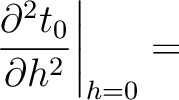
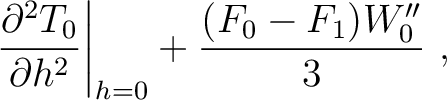
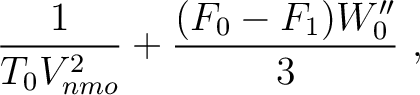
|
 |
 |
 | Effects of lateral heterogeneity on time-domain processing parameters |  |
![[pdf]](icons/pdf.png) |
Next: Numerical implementation Up: Sripanich et al.: Effects Previous: Laterally varying velocity
|
|
|
|
| Effects of lateral heterogeneity on time-domain processing parameters | |
|
 that includes the heterogeneity effects. Twice differentiating the result with respect to
  and
and  and evaluating at the vertical reference (
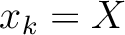 and
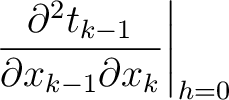
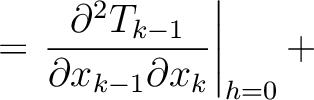
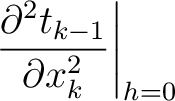
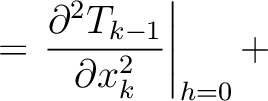
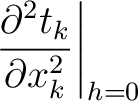
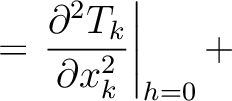
and  ), we arrive at the following layer traveltime derivatives:
 |
 H H |
(15) |
 |
 H H |
|
 |
 H H |
 denotes the traveltime of the
  -th layer in the reference 1-D horizontally-layered anisotropic media with constant elastic parameters within each layer. Therefore, the terms with derivatives are the usual results ones get under the 1-D medium assumption. The additional heterogeneous terms (H
 ) that combine the effects from curved interfaces and laterally varying velocity are given by
H |
 |
(16) |
H |
 |
|
H |
 |
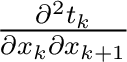 is similar to that of
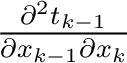 with shifted indices. If a single horizontal layer is considered, equation 11 becomes reminiscent of the result by Grechka and Tsvankin (1999):
but with the second derivative on group slowness as opposed to group velocity.
with shifted indices. If a single horizontal layer is considered, equation 11 becomes reminiscent of the result by Grechka and Tsvankin (1999):
but with the second derivative on group slowness as opposed to group velocity.  is the usual normal-moveout velocity in the reference 1-D medium, which translates to
  in the case of diffraction traveltime.
|
|
|
|
| Effects of lateral heterogeneity on time-domain processing parameters | |
|