|
 |
 |
 | Effects of lateral heterogeneity on time-domain processing parameters |  |
![[pdf]](icons/pdf.png) |
Next: A recursive formula from Up: Sripanich et al.: Effects Previous: Introduction
|
|
|
|
| Effects of lateral heterogeneity on time-domain processing parameters | |
|
 on the interface
  to the receiver
 on the interface
  can be written as
where
can be written as
where  is the number of interfaces and
 for
for
 denotes the point of intersection between the ray and
the
denotes the point of intersection between the ray and
the  -th interface (Figure 1). Every intersection point
and the receiver
-th interface (Figure 1). Every intersection point
and the receiver
 depend on the distance
 , whereas the source at
 does not. The two-point traveltime
  in the -th layer is given by
where
in the -th layer is given by
where  denotes the arc length along the ray between
and
denotes the arc length along the ray between
and
 , and
, and  denotes the group slowness (1/group velocity) of the -th layer that depends on
  . Assuming that in each layer only varies horizontally, equation 2 can be rewritten as
where
. Assuming that in each layer only varies horizontally, equation 2 can be rewritten as
where  denotes the horizontal coordinate (midpoint direction) and
  is the angle of the raypath with respect to the vertical. In the following derivation, we assume that the lateral heterogeneity influences are weak and the resulting traveltime perturbations can be computed with respect to a straight raypath in each homogeneous sublayer. Therefore, we assume that is constant for each -th layer and rewrite equation 3 as follows (Grechka and Tsvankin, 1999; Lynn and Claerbout, 1982):
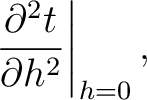
Equations 1 and 4 serve as the basis for our construction in this study, where we seek the following second-order total one-way traveltime derivative,
evaluated at with respect to the reference vertical ray in a 1-D anisotropic medium (Figure 1). We denote the reference intersection point by
 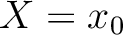 and use `capital letters' to denote quantities evaluated with respect to the reference 1-D anisotropic medium.
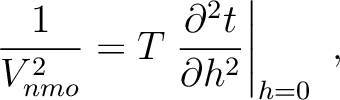
In consideration of reflection traveltime, equation 5 is related to the NMO velocity as follows:
where is the one-way zero-offset traveltime from the point
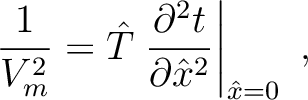
 on the reflector to the surface. In the case of diffraction traveltime, equation 5 can be related to time-migration velocity as follows:
where
on the reflector to the surface. In the case of diffraction traveltime, equation 5 can be related to time-migration velocity as follows:
where  is the one-way vertical traveltime from the point scatterer
to the surface and we replace
is the one-way vertical traveltime from the point scatterer
to the surface and we replace  with
with
 . Even though and
  have the same mathematical expression, they represent two different quantities. In case of reflection traveltime, it is common to use to denote half-offset. On the other hand, in consideration of diffraction traveltime, we use here to denote the distance between the escape location
  of image ray and any surrounding point
  on the surface. We give a brief review on the derivation of equations 6 and 7 in Appendix A.
Because both NMO velocity (equation 6) for reflection traveltime and time-migration velocity (equation 7) for diffraction traveltime are related to the one-way traveltime derivative of a ray (either normal-incidence or image ray), it is, in principle, sufficient to study the effects from lateral heterogeneity on such derivative of a generic ray travelling between a subsurface position and the surface. We shall adopt this notion in this paper and begin our study by first looking at how the desired second-order one-way traveltime derivative evaluated at the surface (equation 5) is related to the derivatives of  in each sublayer based on the Fermat's principle. This relationship will be used to accumulate the total effects of lateral heterogeneity from all sublayers.
|
|
|
|
| Effects of lateral heterogeneity on time-domain processing parameters | |
|




 where
where