sfintbin uses trace headers to arrange input traces in a 3-D cube.
The input to this program typically comes from reading a SEGY file with sfsegyread.
The following example from tccs/phase/boon3 shows a typical output:
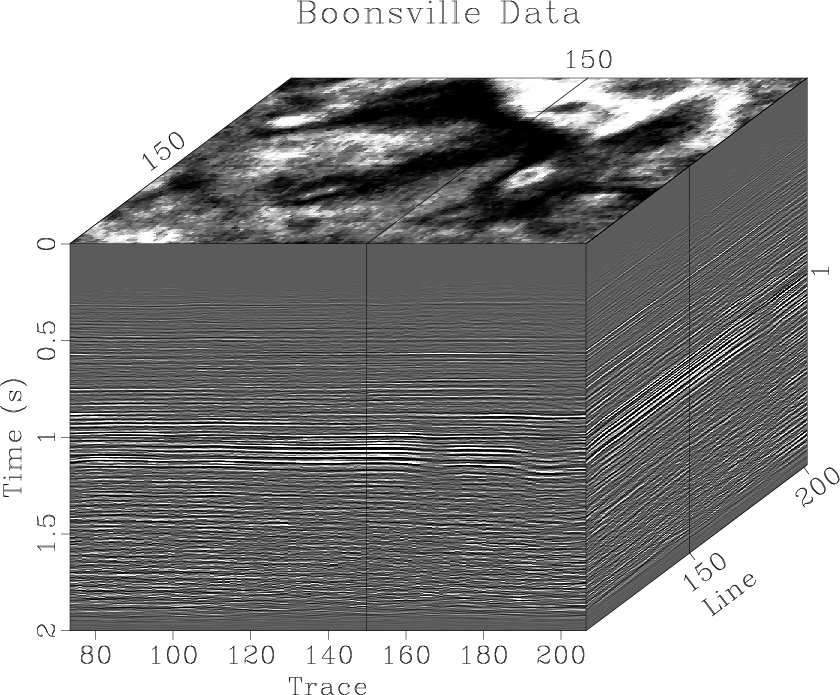
sfintbin takes as an input a 2-D trace file and its corresponding trace header file (specified by head=). The header file is assumed to contain integer values. The output 3-D cube is generated according to trace header keys, which can be specified by name (xk=, yk=) or by number (xkey=, ykey=). In the example above, the parameters are xk=cdp and yk=fldr. If you are unsure which keys to use, try sfheaderattr. The range of values can be controlled with xmin=, xmax=, ymin=, ymax=.
sfintbin performs a very simple operation: it goes through the input file and assigns traces to the output according to their header keys. If there are several traces with the same x and y keys, the last one survives. If there are bins in the output with no input, they are filled with zeros. You can output the mask of empty traces using mask=. You can output the mapping of traces using map=. The latter is particularly useful for the inverse operation (mapping from 3-D back to 2-D), which can be performed with inv=y.
For an absent trace header key, which corresponds to a trace number in a gather, you can set xkey= to a negative number. For this to work, the input needs to be sorted in the corresponding gathers, which can be accomplished with sfheadersort.
To produce a 4-D output (for example, a set of gathers in 3-D), try sfintbin3.


 The Madagascar School for Advanced Users is being planned for August 8-9, 2015. The school will take place in Qingdao, China, and will be hosted by the China University of Petroleum. Unlike
  The Working Workshop on 3D Seismic Data Processing is being planned for August 19-22, 2015. The workshop will take place in Houston and will be hosted by Rice University. Unlike

 An article