![[pdf]](icons/pdf.png)
|
|
|
|
| Velocity continuation by spectral methods | |
|
 grid transform
The first problem is the loss of information in the transform to the
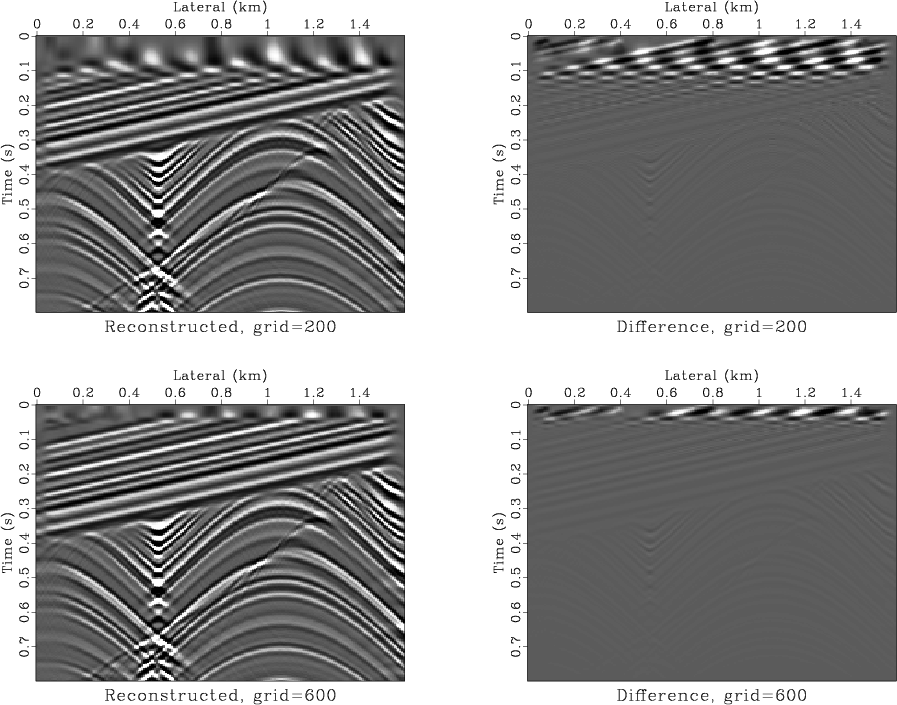
grid. As illustrated in Figure 2, the shallow part of
the data gets severely compressed in the grid. The amount of
compression can lead to inadequate sampling, and as a result, aliasing
artifacts in the frequency domain. Moreover, it can be difficult to
recover from the loss of information in the transformed domain when
transforming back into the original grid. A partial remedy for this
problem is to increase the grid size in the domain. The top plots
in Figure 4 show the result of back transformation to
the  grid and the difference between this result and the original
model (plotted on the same scale). We can see a noticeable loss of
information in the upper (shallow) part of the data, caused by
undersampling. The bottom plots in Figure 4 correspond
to increasing the grid size by a factor of three. Some of the
artifacts have been suppressed, at the expense of dealing with a
larger grid.
grid and the difference between this result and the original
model (plotted on the same scale). We can see a noticeable loss of
information in the upper (shallow) part of the data, caused by
undersampling. The bottom plots in Figure 4 correspond
to increasing the grid size by a factor of three. Some of the
artifacts have been suppressed, at the expense of dealing with a
larger grid.
|
|---|
|
fft-inv
Figure 4. The left plots show the reconstruction of the original data after transforming back from the grid to the original
grid. The right plots show the difference with the original model.
Top: using the original grid size ( ). Bottom: increasing
the grid size by a factor of three. ). Bottom: increasing
the grid size by a factor of three.
|
![[scons]](icons/configure.png)
|
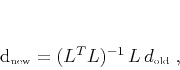
To perform an accurate transform of the grid, I adopted the following
method, inspired by (Claerbout, 1986a). Let
 denote the data on the new grid and
 be the data on the old grid. If
  is the interpolation operator,
defined on the new grid, then the optimal least-square transformation
is
is the interpolation operator,
defined on the new grid, then the optimal least-square transformation
is
 denotes the adjoint interpolation operator. The operator
 provides a proper scaling of the result. If we use
simple linear interpolation for the operator, then
provides a proper scaling of the result. If we use
simple linear interpolation for the operator, then  is a
tridiagonal matrix, which can be easily inverted (in
is a
tridiagonal matrix, which can be easily inverted (in  operations). If some parts in
are not fully
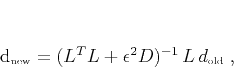
constrained, then the tridiagonal matrix is not invertible. To obtain
a solution in this case, we can include a regularization operator
operations). If some parts in
are not fully
constrained, then the tridiagonal matrix is not invertible. To obtain
a solution in this case, we can include a regularization operator  in (8), as follows:
is a second derivative operator,
represented with the second-order finite-difference approximation.
This operator allows the selection of the smoothest possible function
in (8), as follows:
is a second derivative operator,
represented with the second-order finite-difference approximation.
This operator allows the selection of the smoothest possible function
 while preserving the efficient tridiagonal structure
of
while preserving the efficient tridiagonal structure
of
 . In this problem, the parameter
  can be chosen as small as possible, as long as it prevents the
inversion from getting unstable.
can be chosen as small as possible, as long as it prevents the
inversion from getting unstable.
|
|
|
|
| Velocity continuation by spectral methods | |
|