![[pdf]](icons/pdf.png)
|
|
|
|
| Velocity continuation by spectral methods | |
|
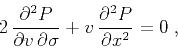
Introducing the change of variable  , we can transform
equation (1) to the form
, we can transform
equation (1) to the form
 and
and  further simplifies equation (5)
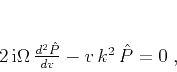
to the ordinary differential equation
further simplifies equation (5)
to the ordinary differential equation
 corresponds to the time coordinate
, and
corresponds to the time coordinate
, and  is the wavenumber in . Equation (6) has
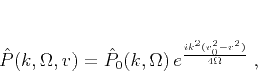
an explicit analytical solution
is the wavenumber in . Equation (6) has
an explicit analytical solution
 to a regular grid
in .
and .
to a regular grid
in .
and .
 .
and .
.
.
and .
.
|
|---|
|
t2
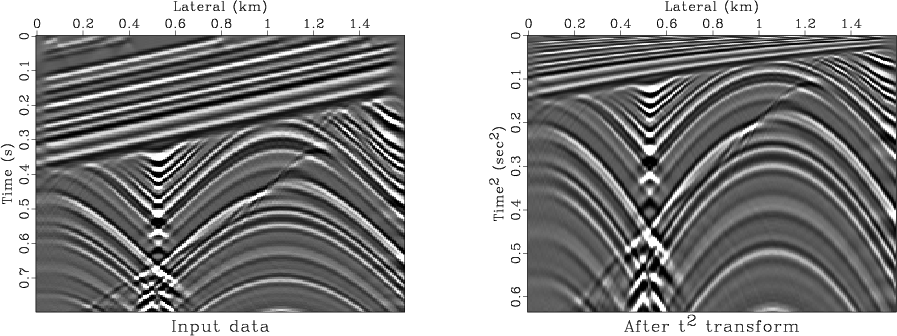
Figure 2. Synthetic seismic data before (left) and after (right) transformation to the grid.
|
![[scons]](icons/configure.png)
|
Figure 2 shows a simple synthetic model of seismic
reflection data from (Claerbout, 1995) before and after
transforming the grid, regularly spaced in , to a grid, regular in
. The left plot of Figure 3 shows the Fourier
transform of the data. Except for the nearly vertical event, which
corresponds to a stack of parallel layers in the shallow part of the
data, the data frequency range is contained near the origin in the
 space. The right plot of Figure 3 shows the
phase-shift filter for continuation from zero imaging velocity (which
corresponds to unprocessed data) to the velocity of 1 km/sec. The
rapidly oscillating part (small frequencies and large wavenumbers) is
exactly in the place, where the data spectrum is zero and corresponds
to physically impossible reflection events.
space. The right plot of Figure 3 shows the
phase-shift filter for continuation from zero imaging velocity (which
corresponds to unprocessed data) to the velocity of 1 km/sec. The
rapidly oscillating part (small frequencies and large wavenumbers) is
exactly in the place, where the data spectrum is zero and corresponds
to physically impossible reflection events.

|
|---|
|
t2-fft
Figure 3. Left: the real part of the data Fourier transform. Right: the real part of the velocity continuation operator (continuation from 0 to 1 km/s) in the Fourier domain. |
|
|
Algorithm (7) is very attractive from the practical point
of view because of its efficiency (based on the FFT algorithm). The
operations count is roughly the same as in Stolt migration
(4): two forward and inverse FFTs and forward and inverse
grid transform with interpolation (one complex-number transform in the
case of Stolt migration). Algorithm (7) can be even more
efficient than Stolt method because of the simpler structure of the
innermost loop. However, its practical implementation faces two
difficult problems: artifacts of the  grid transform and
wraparound artifacts
grid transform and
wraparound artifacts
|
|
|
|
| Velocity continuation by spectral methods | |
|