![[pdf]](icons/pdf.png)
|
|
|
|
| Spectral factorization revisited | |
|
 |
(9) |
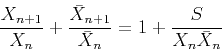
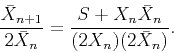
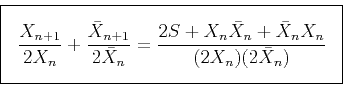
In an analogous way, we can take the general relation from
Table 3
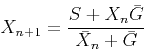
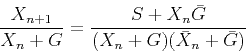
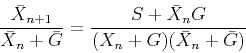
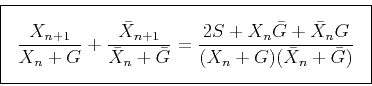
Equation (11) represents our general formula for
spectral factorization. If we consider the particular case when  is
is
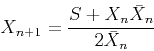
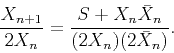
 , we obtain equation (10), which we have shown
to be equivalent to the Wilson-Burg formula.
, we obtain equation (10), which we have shown
to be equivalent to the Wilson-Burg formula.
From the computational standpoint, our equation is more expensive than
the Wilson-Burg because it requires two more convolutions on the
numerator of the right-hand side. However, our equation offers more
flexibility in the convergence rate. If we try to achieve a quick
convergence, we can take to be and get the Wilson-Burg
equation. On the other hand, if we worry about the stability,
especially when some of the
roots of the auto-correlation function are close to the unit circle,
and we fear losing the minimum-phase property of the factors,
we can take to be some damping function, more tolerant of
numerical errors.
Moreover, by using the Equation (11), we can achieve
fast convergence in cases when the auto-correlations we are
factorizing have a very similar form, for example, in nonstationary
filtering. In such cases, the solution at the preceding step can be
used as the function in the new factorization. Since is already
very close to the solution, the convergence is likely to occur quite
fast.
|
|
|
|
| Spectral factorization revisited | |
|