Guide to programming with madagascar
This guide demonstrates a simple time-domain finite-differences modeling code in RSF.
Introduction[edit]
This section presents time-domain finite-difference modeling [1] written with the RSF library. The C, C++, and Fortran 90 interfaces demonstrate the program. The acoustic wave-equation
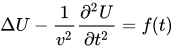
can be written as
![{\displaystyle \left[\Delta U-f(t)\right]v^{2}={\frac {\partial ^{2}U}{\partial t^{2}}}\;.}](https://wikimedia.org/api/rest_v1/media/math/render/svg/7a7a9f43db1d57e7cce813a59157c85fd99e1987)
is the Laplacian symbol, is the source wavelet, is the velocity, and is a scalar wavefield. A discrete-time step involves the following computations:


![{\displaystyle U_{i+1}=\left[\Delta U-f(t)\right]v^{2}\Delta t^{2}+2U_{i}-U_{i-1}\;,}](https://wikimedia.org/api/rest_v1/media/math/render/svg/45c37e544f93dd77b95fe3b70c09a86802a84728)
where , and represent the propagating wavefield at various time steps.


C program[edit]

C program[edit]
<syntaxhighlight lang="c"> /* time-domain acoustic FD modeling */
- include <rsf.h>
int main(int argc, char* argv[]) {
   /* Laplacian coefficients */
   float c0=-30./12.,c1=+16./12.,c2=- 1./12.;
   bool verb;           /* verbose flag */
   sf_file Fw=NULL,Fv=NULL,Fr=NULL,Fo=NULL; /* I/O files */
   sf_axis at,az,ax;    /* cube axes */
   int it,iz,ix;        /* index variables */
   int nt,nz,nx;
   float dt,dz,dx,idx,idz,dt2;
   float  *ww,**vv,**rr;     /* I/O arrays*/
   float **um,**uo,**up,**ud;/* tmp arrays */
   sf_init(argc,argv);
   if(! sf_getbool("verb",&verb)) verb=0; /* verbose flag */
   /* setup I/O files */
   Fw = sf_input ("in" );
   Fo = sf_output("out");
   Fv = sf_input ("vel");
   Fr = sf_input ("ref");
   /* Read/Write axes */
   at = sf_iaxa(Fw,1); nt = sf_n(at); dt = sf_d(at);
   az = sf_iaxa(Fv,1); nz = sf_n(az); dz = sf_d(az);
   ax = sf_iaxa(Fv,2); nx = sf_n(ax); dx = sf_d(ax);
   sf_oaxa(Fo,az,1);
   sf_oaxa(Fo,ax,2);
   sf_oaxa(Fo,at,3);
   dt2 =    dt*dt;
   idz = 1/(dz*dz);
   idx = 1/(dx*dx);
   /* read wavelet, velocity & reflectivity */
   ww=sf_floatalloc(nt);     sf_floatread(ww   ,nt   ,Fw);
   vv=sf_floatalloc2(nz,nx); sf_floatread(vv[0],nz*nx,Fv);
   rr=sf_floatalloc2(nz,nx); sf_floatread(rr[0],nz*nx,Fr);
   /* allocate temporary arrays */
   um=sf_floatalloc2(nz,nx);
   uo=sf_floatalloc2(nz,nx);
   up=sf_floatalloc2(nz,nx);
   ud=sf_floatalloc2(nz,nx);
for (ix=0; ix<nx; ix++) {
for (iz=0; iz<nz; iz++) { um[ix][iz]=0; uo[ix][iz]=0; up[ix][iz]=0; ud[ix][iz]=0; }
}
   /* MAIN LOOP */
   if(verb) fprintf(stderr,"
");
for (it=0; it<nt; it++) {
if(verb) fprintf(stderr,"\b\b\b\b\b %d",it);
/* 4th order laplacian */ for (ix=2; ix<nx-2; ix++) { for (iz=2; iz<nz-2; iz++) { ud[ix][iz] = c0* uo[ix ][iz ] * (idx+idz) + c1*(uo[ix-1][iz ] + uo[ix+1][iz ])*idx + c2*(uo[ix-2][iz ] + uo[ix+2][iz ])*idx + c1*(uo[ix ][iz-1] + uo[ix ][iz+1])*idz + c2*(uo[ix ][iz-2] + uo[ix ][iz+2])*idz; } }
/* inject wavelet */ for (ix=0; ix<nx; ix++) { for (iz=0; iz<nz; iz++) { ud[ix][iz] -= ww[it] * rr[ix][iz]; } }
/* scale by velocity */ for (ix=0; ix<nx; ix++) { for (iz=0; iz<nz; iz++) { ud[ix][iz] *= vv[ix][iz]*vv[ix][iz]; } }
/* time step */ for (ix=0; ix<nx; ix++) { for (iz=0; iz<nz; iz++) { up[ix][iz] = 2*uo[ix][iz] - um[ix][iz] + ud[ix][iz] * dt2;
um[ix][iz] = uo[ix][iz]; uo[ix][iz] = up[ix][iz]; } }
/* write wavefield to output */ sf_floatwrite(uo[0],nz*nx,Fo);
   }
   if(verb) fprintf(stderr,"\n");
exit (0);
} </syntaxhighlight>
- Declare input, output and auxiliary file tags: Fw for input wavelet, Fv for velocity, Fr for reflectivity, and Fo for output wavefield. <syntaxhighlight lang="c">
sf_file Fw=NULL,Fv=NULL,Fr=NULL,Fo=NULL; /* I/O files */
</syntaxhighlight>
- Declare RSF cube axes: at time axis, ax space axis, az depth axis. \tiny <syntaxhighlight lang="c">
sf_axis at,az,ax; /* cube axes */
</syntaxhighlight>
- Declare multi-dimensional arrays for input, output, and computations. <syntaxhighlight lang="c">
float *ww,**vv,**rr; /* I/O arrays*/
</syntaxhighlight>
- Open files for input/output. <syntaxhighlight lang="c">
   Fw = sf_input ("in" );
   Fo = sf_output("out");
   Fv = sf_input ("vel");
   Fr = sf_input ("ref");
</syntaxhighlight>
- Read axes from input files; write axes to output file. <syntaxhighlight lang="c">
   at = sf_iaxa(Fw,1); nt = sf_n(at); dt = sf_d(at);
   az = sf_iaxa(Fv,1); nz = sf_n(az); dz = sf_d(az);
   ax = sf_iaxa(Fv,2); nx = sf_n(ax); dx = sf_d(ax);
   sf_oaxa(Fo,az,1);
   sf_oaxa(Fo,ax,2);
   sf_oaxa(Fo,at,3);
</syntaxhighlight>
- Allocate arrays and read wavelet, velocity, and reflectivity. <syntaxhighlight lang="c">
   ww=sf_floatalloc(nt);     sf_floatread(ww   ,nt   ,Fw);
   vv=sf_floatalloc2(nz,nx); sf_floatread(vv[0],nz*nx,Fv);
   rr=sf_floatalloc2(nz,nx); sf_floatread(rr[0],nz*nx,Fr);
</syntaxhighlight>
- Allocate temporary arrays. <syntaxhighlight lang="c">
   um=sf_floatalloc2(nz,nx);
   uo=sf_floatalloc2(nz,nx);
   up=sf_floatalloc2(nz,nx);
   ud=sf_floatalloc2(nz,nx);
</syntaxhighlight>
- Loop over time. <syntaxhighlight lang="c">
for (it=0; it<nt; it++) {
</syntaxhighlight>
- Compute Laplacian: . <syntaxhighlight lang="c">

for (ix=2; ix<nx-2; ix++) { for (iz=2; iz<nz-2; iz++) { ud[ix][iz] = c0* uo[ix ][iz ] * (idx+idz) + c1*(uo[ix-1][iz ] + uo[ix+1][iz ])*idx + c2*(uo[ix-2][iz ] + uo[ix+2][iz ])*idx + c1*(uo[ix ][iz-1] + uo[ix ][iz+1])*idz + c2*(uo[ix ][iz-2] + uo[ix ][iz+2])*idz; } } </syntaxhighlight>
- Inject source wavelet: <syntaxhighlight lang="c">
![{\displaystyle \left[\Delta U-f(t)\right]}](https://wikimedia.org/api/rest_v1/media/math/render/svg/6293bcba5d94776d76c85f7aa28ac2de448f9a40)
for (ix=0; ix<nx; ix++) { for (iz=0; iz<nz; iz++) { ud[ix][iz] -= ww[it] * rr[ix][iz]; } } </syntaxhighlight>
- Scale by velocity: <syntaxhighlight lang="c">
![{\displaystyle \left[\Delta U-f(t)\right]v^{2}}](https://wikimedia.org/api/rest_v1/media/math/render/svg/0e8cfb61e8f925b152665f7ae15eba9995973389)
for (ix=0; ix<nx; ix++) { for (iz=0; iz<nz; iz++) { ud[ix][iz] *= vv[ix][iz]*vv[ix][iz]; } } </syntaxhighlight>
- Time step: <syntaxhighlight lang="c">
![{\displaystyle U_{i+1}=\left[\Delta U-f(t)\right]v^{2}\Delta t^{2}+2U_{i}-U_{i-1}}](https://wikimedia.org/api/rest_v1/media/math/render/svg/4ce8ac5ae71b46bdda2229b4e200ff98f9a2f174)
for (ix=0; ix<nx; ix++) { for (iz=0; iz<nz; iz++) { up[ix][iz] = 2*uo[ix][iz] - um[ix][iz] + ud[ix][iz] * dt2;
um[ix][iz] = uo[ix][iz]; uo[ix][iz] = up[ix][iz]; } } </syntaxhighlight>
\newpage
C++ program[edit]
<syntaxhighlight lang="cpp"> // time-domain acoustic FD modeling
- include <valarray>
- include <iostream>
- include <rsf.hh>
- include <cub.hh>
- include "vai.hh"
using namespace std;
int main(int argc, char* argv[]) {
   // Laplacian coefficients
   float c0=-30./12.,c1=+16./12.,c2=- 1./12.;
   sf_init(argc,argv);// init RSF
   bool verb;         // vebose flag
   if(! sf_getbool("verb",&verb)) verb=0;
   // setup I/O files
   CUB Fw("in", "i"); Fw.headin(); //Fw.report();
   CUB Fv("vel","i"); Fv.headin(); //Fv.report();
   CUB Fr("ref","i"); Fr.headin(); //Fr.report();
   CUB Fo("out","o"); Fo.setup(3);
   // Read/Write axes
   sf_axis at = Fw.getax(0); int nt = sf_n(at); float dt = sf_d(at);
   sf_axis az = Fv.getax(0); int nz = sf_n(az); float dz = sf_d(az);
   sf_axis ax = Fv.getax(1); int nx = sf_n(ax); float dx = sf_d(ax);
   Fo.putax(0,az);
   Fo.putax(1,ax);
   Fo.putax(2,at);
   Fo.headou();
   float dt2 =    dt*dt;
   float idz = 1/(dz*dz);
   float idx = 1/(dx*dx);
   // read wavelet, velocity and reflectivity
   valarray<float> ww( nt    ); ww=0; Fw >> ww;
   valarray<float> vv( nz*nx ); vv=0; Fv >> vv;
   valarray<float> rr( nz*nx ); rr=0; Fr >> rr;

   // allocate temporary arrays
   valarray<float> um(nz*nx); um=0;
   valarray<float> uo(nz*nx); uo=0;
   valarray<float> up(nz*nx); up=0;
   valarray<float> ud(nz*nx); ud=0;
   // init ValArray Index counter
   VAI k(nz,nx);
   // MAIN LOOP
   if(verb) cerr << endl;
   for (int it=0; it<nt; it++) {
if(verb) cerr << "\b\b\b\b\b" << it;
// 4th order laplacian for (int ix=2; ix<nx-2; ix++) { for (int iz=2; iz<nz-2; iz++) { ud[k(iz,ix)] = c0* uo[ k(iz ,ix )] * (idx+idz) + c1*(uo[ k(iz ,ix-1)]+uo[ k(iz ,ix+1)]) * idx + c1*(uo[ k(iz-1,ix )]+uo[ k(iz+1,ix )]) * idz + c2*(uo[ k(iz ,ix-2)]+uo[ k(iz ,ix+2)]) * idx + c2*(uo[ k(iz-2,ix )]+uo[ k(iz+2,ix )]) * idz; } }
// inject wavelet ud -= ww[it] * rr;
// scale by velocity ud *= vv*vv;
// time step up=(float)2 * uo - um + ud * dt2; um = uo; uo = up;
// write wavefield to output output Fo << uo;
   }
   if(verb) cerr << endl;
exit(0);
}
</syntaxhighlight>
- Declare input, output, and auxiliary file cubes (of type CUB). <syntaxhighlight lang="cpp">
   CUB Fw("in", "i"); Fw.headin(); //Fw.report();
   CUB Fv("vel","i"); Fv.headin(); //Fv.report();
   CUB Fr("ref","i"); Fr.headin(); //Fr.report();
   CUB Fo("out","o"); Fo.setup(3);
</syntaxhighlight>
- Declare, read and write RSF cube axes: at time axis, ax space axis, az depth axis. <syntaxhighlight lang="cpp">
   sf_axis at = Fw.getax(0); int nt = sf_n(at); float dt = sf_d(at);
   sf_axis az = Fv.getax(0); int nz = sf_n(az); float dz = sf_d(az);
   sf_axis ax = Fv.getax(1); int nx = sf_n(ax); float dx = sf_d(ax);
</syntaxhighlight>
- Declare multi-dimensional valarrays for input, output and read data. <syntaxhighlight lang="cpp">
   valarray<float> ww( nt    ); ww=0; Fw >> ww;
   valarray<float> vv( nz*nx ); vv=0; Fv >> vv;
   valarray<float> rr( nz*nx ); rr=0; Fr >> rr;
</syntaxhighlight>
- Declare multi-dimensional valarrays for temporary storage. <syntaxhighlight lang="cpp">
   valarray<float> um(nz*nx); um=0;
   valarray<float> uo(nz*nx); uo=0;
   valarray<float> up(nz*nx); up=0;
   valarray<float> ud(nz*nx); ud=0;
</syntaxhighlight>
- Initialize multidimensional valarray index counter (of type VAI). <syntaxhighlight lang="cpp">
VAI k(nz,nx);
</syntaxhighlight>
- Loop over time. <syntaxhighlight lang="cpp">
for (int it=0; it<nt; it++) {
</syntaxhighlight>
- Compute Laplacian: . <syntaxhighlight lang="cpp">
for (int ix=2; ix<nx-2; ix++) { for (int iz=2; iz<nz-2; iz++) { ud[k(iz,ix)] = c0* uo[ k(iz ,ix )] * (idx+idz) + c1*(uo[ k(iz ,ix-1)]+uo[ k(iz ,ix+1)]) * idx + c1*(uo[ k(iz-1,ix )]+uo[ k(iz+1,ix )]) * idz + c2*(uo[ k(iz ,ix-2)]+uo[ k(iz ,ix+2)]) * idx + c2*(uo[ k(iz-2,ix )]+uo[ k(iz+2,ix )]) * idz; } } </syntaxhighlight>
- Inject source wavelet: <syntaxhighlight lang="cpp">
ud -= ww[it] * rr; </syntaxhighlight>
- Scale by velocity: <syntaxhighlight lang="cpp">
ud *= vv*vv; </syntaxhighlight>
- Time step: <syntaxhighlight lang="cpp">
up=(float)2 * uo - um + ud * dt2; um = uo; uo = up; </syntaxhighlight>
Fortran 90 program[edit]
<syntaxhighlight lang="fortran"> ! time-domain acoustic FD modeling program AFDMf90
use rsf
implicit none
 ! Laplacian coefficients
 real :: c0=-30./12.,c1=+16./12.,c2=- 1./12.
 logical    :: verb         ! verbose flag
 type(file) :: Fw,Fv,Fr,Fo  ! I/O files
 type(axa)  :: at,az,ax     ! cube axes
 integer    :: it,iz,ix     ! index variables
 integer    :: nt,nz,nx
 real       :: dt,dz,dx
 real       :: idx,idz,dt2
 real, allocatable :: vv(:,:),rr(:,:),ww(:)           ! I/O arrays
 real, allocatable :: um(:,:),uo(:,:),up(:,:),ud(:,:) ! tmp arrays
 call sf_init() ! init RSF
 call from_par("verb",verb,.false.)
 ! Setup I/O files
 Fw=rsf_input ("in")
 Fv=rsf_input ("vel")
 Fr=rsf_input ("ref")
 Fo=rsf_output("out")
 ! Read/Write axes
 call iaxa(Fw,at,1); nt = at%n; dt = at%d
 call iaxa(Fv,az,1); nz = az%n; dz = az%d
 call iaxa(Fv,ax,2); nx = ax%n; dx = ax%d

 call oaxa(Fo,az,1)
 call oaxa(Fo,ax,2)
 call oaxa(Fo,at,3)
 dt2 =    dt*dt
 idz = 1/(dz*dz)
 idx = 1/(dx*dx)
 ! read wavelet, velocity & reflectivity
 allocate(ww(nt));    call rsf_read(Fw,ww)
 allocate(vv(nz,nx)); call rsf_read(Fv,vv)
 allocate(rr(nz,nx)); call rsf_read(Fr,rr)
 ! allocate temporary arrays
 allocate(um(nz,nx)); um=0.
 allocate(uo(nz,nx)); uo=0.
 allocate(up(nz,nx)); up=0.
 allocate(ud(nz,nx)); ud=0.
 ! MAIN LOOP
 do it=1,nt
    if(verb) write (0,*) it
    ud(3:nz-2,3:nx-2) = &
         c0* uo(3:nz-2,3:nx-2) * (idx + idz)            + &
         c1*(uo(3:nz-2,2:nx-3) + uo(3:nz-2,4:nx-1))*idx + &
         c2*(uo(3:nz-2,1:nx-4) + uo(3:nz-2,5:nx  ))*idx + &
         c1*(uo(2:nz-3,3:nx-2) + uo(4:nz-1,3:nx-2))*idz + &
         c2*(uo(1:nz-4,3:nx-2) + uo(5:nz  ,3:nx-2))*idz
    ! inject wavelet
    ud = ud - ww(it) * rr
    ! scale by velocity
    ud= ud *vv*vv
    ! time step
    up = 2*uo - um + ud * dt2
    um =   uo
    uo =   up
    ! write wavefield to output
    call rsf_write(Fo,uo)
 end do
call exit(0)
end program AFDMf90 </syntaxhighlight>
- Declare input, output, and auxiliary file tags. <syntaxhighlight lang="fortran">
type(file) :: Fw,Fv,Fr,Fo ! I/O files
</syntaxhighlight>
- Declare RSF cube axes: at time axis, ax space axis, az depth axis. <syntaxhighlight lang="fortran">
type(axa) :: at,az,ax ! cube axes
</syntaxhighlight>
- Declare multi-dimensional arrays for input, output, and computations. <syntaxhighlight lang="fortran">
 real, allocatable :: vv(:,:),rr(:,:),ww(:)           ! I/O arrays
 real, allocatable :: um(:,:),uo(:,:),up(:,:),ud(:,:) ! tmp arrays
</syntaxhighlight>
- Open files for input/output. <syntaxhighlight lang="fortran">
 Fw=rsf_input ("in")
 Fv=rsf_input ("vel")
 Fr=rsf_input ("ref")
 Fo=rsf_output("out")
</syntaxhighlight>
- Read axes from input files; write axes to output file. <syntaxhighlight lang="fortran">
 call iaxa(Fw,at,1); nt = at%n; dt = at%d
 call iaxa(Fv,az,1); nz = az%n; dz = az%d
 call iaxa(Fv,ax,2); nx = ax%n; dx = ax%d

 call oaxa(Fo,az,1)
 call oaxa(Fo,ax,2)
 call oaxa(Fo,at,3)
</syntaxhighlight>
- Allocate arrays and read wavelet, velocity, and reflectivity. <syntaxhighlight lang="fortran">
 allocate(ww(nt));    call rsf_read(Fw,ww)
 allocate(vv(nz,nx)); call rsf_read(Fv,vv)
 allocate(rr(nz,nx)); call rsf_read(Fr,rr)
</syntaxhighlight>
- Allocate temporary arrays. <syntaxhighlight lang="fortran">
 allocate(um(nz,nx)); um=0.
 allocate(uo(nz,nx)); uo=0.
 allocate(up(nz,nx)); up=0.
 allocate(ud(nz,nx)); ud=0.
</syntaxhighlight>
- Loop over time. <syntaxhighlight lang="fortran">
do it=1,nt
</syntaxhighlight>
- Compute Laplacian: . <syntaxhighlight lang="fortran">
    ud(3:nz-2,3:nx-2) = &
         c0* uo(3:nz-2,3:nx-2) * (idx + idz)            + &
         c1*(uo(3:nz-2,2:nx-3) + uo(3:nz-2,4:nx-1))*idx + &
         c2*(uo(3:nz-2,1:nx-4) + uo(3:nz-2,5:nx  ))*idx + &
         c1*(uo(2:nz-3,3:nx-2) + uo(4:nz-1,3:nx-2))*idz + &
         c2*(uo(1:nz-4,3:nx-2) + uo(5:nz  ,3:nx-2))*idz
</syntaxhighlight>
- Inject source wavelet: <syntaxhighlight lang="fortran">
ud = ud - ww(it) * rr
</syntaxhighlight>
- Scale by velocity: <syntaxhighlight lang="fortran">
ud= ud *vv*vv
</syntaxhighlight>
- Time step: <syntaxhighlight lang="fortran">
    up = 2*uo - um + ud * dt2
    um =   uo
    uo =   up
</syntaxhighlight>
Python program[edit]
<syntaxhighlight lang="python">
- !/usr/bin/env python
import sys import numpy import m8r
c0=-30./12. c1=+16./12. c2=- 1./12.
par = m8r.Par() verb = par.bool("verb",False) # verbosity
- setup I/O files
Fw=m8r.Input() Fv=m8r.Input ("vel") Fr=m8r.Input ("ref") Fo=m8r.Output()
- Read/Write axes
at = Fw.axis(1); nt = at['n']; dt = at['d'] az = Fv.axis(1); nz = az['n']; dz = az['d'] ax = Fv.axis(2); nx = ax['n']; dx = ax['d']
Fo.putaxis(az,1) Fo.putaxis(ax,2) Fo.putaxis(at,3)
dt2 = dt*dt idz = 1/(dz*dz) idx = 1/(dx*dx)
- read wavelet, velocity & reflectivity
ww = numpy.zeros(nt,'f'); Fw.read(ww) vv = numpy.zeros([nz,nx],'f'); Fv.read(vv) rr = numpy.zeros([nz,nx],'f'); Fr.read(rr)
- allocate temporary arrays
um = numpy.zeros([nz,nx],'f') uo = numpy.zeros([nz,nx],'f') up = numpy.zeros([nz,nx],'f') ud = numpy.zeros([nz,nx],'f')
- MAIN LOOP
for it in range(nt):
   if verb:
       sys.stderr.write("\b\b\b\b\b %d" % it)
   ud[2:-2,2:-2] = \
   c0* uo[2:-2,2:-2] * (idx + idz)        + \
   c1*(uo[2:-2,1:-3] + uo[2:-2,3:-1])*idx + \
   c2*(uo[2:-2, :-4] + uo[2:-2,4:  ])*idx + \
   c1*(uo[1:-3,2:-2] + uo[3:-1,2:-2])*idz + \
   c2*(uo[ :-4,2:-2] + uo[4:  ,2:-2])*idz
   # inject wavelet
   ud = ud - ww[it] * rr
   # scale by velocity
   ud= ud *vv*vv
   # time step
   up = 2*uo - um + ud * dt2
   um =   uo
   uo =   up
if verb:
   sys.stderr.write("\n")
   Fo.write(uo)
sys.exit(0) </syntaxhighlight>

- Open files for input/output. <syntaxhighlight lang="python">
Fw=m8r.Input() Fv=m8r.Input ("vel") Fr=m8r.Input ("ref") Fo=m8r.Output() </syntaxhighlight>
- Read axes from input files; write axes to output file. <syntaxhighlight lang="python">
at = Fw.axis(1); nt = at['n']; dt = at['d'] az = Fv.axis(1); nz = az['n']; dz = az['d'] ax = Fv.axis(2); nx = ax['n']; dx = ax['d']
Fo.putaxis(az,1) Fo.putaxis(ax,2) Fo.putaxis(at,3) </syntaxhighlight>
- Allocate arrays and read wavelet, velocity, and reflectivity. <syntaxhighlight lang="python">
ww = numpy.zeros(nt,'f'); Fw.read(ww) vv = numpy.zeros([nz,nx],'f'); Fv.read(vv) rr = numpy.zeros([nz,nx],'f'); Fr.read(rr) </syntaxhighlight>
- Allocate temporary arrays. <syntaxhighlight lang="python">
um = numpy.zeros([nz,nx],'f') uo = numpy.zeros([nz,nx],'f') up = numpy.zeros([nz,nx],'f') ud = numpy.zeros([nz,nx],'f') </syntaxhighlight>
- Loop over time. <syntaxhighlight lang="python">
for it in range(nt): </syntaxhighlight>
- Compute Laplacian: . <syntaxhighlight lang="python">
   ud[2:-2,2:-2] = \
   c0* uo[2:-2,2:-2] * (idx + idz)        + \
   c1*(uo[2:-2,1:-3] + uo[2:-2,3:-1])*idx + \
   c2*(uo[2:-2, :-4] + uo[2:-2,4:  ])*idx + \
   c1*(uo[1:-3,2:-2] + uo[3:-1,2:-2])*idz + \
   c2*(uo[ :-4,2:-2] + uo[4:  ,2:-2])*idz
</syntaxhighlight>
- Inject source wavelet: <syntaxhighlight lang="python">
ud = ud - ww[it] * rr
</syntaxhighlight>
- Scale by velocity: <syntaxhighlight lang="python">
ud= ud *vv*vv
</syntaxhighlight>
- Time step: <syntaxhighlight lang="python">
   up = 2*uo - um + ud * dt2
   um =   uo
   uo =   up
</syntaxhighlight>
References[edit]
- ↑ "Hello world" of seismic imaging.