Hello WordPress!

August 29, 2015 Links No comments

wordpress This blog is changing its appearance by moving its engine from Serendipity to WordPress. The new engine should make it more convenient to leave comments and to interact with the blog content. Markdown editing is enabled. The old blog will remain available until all links are properly redirected. According to wappalyzer.com, WordPress currently dominates the market of Content Management Systems (CMS). According to builtwith.com, it powers 50% of all websites on the entire Internet. This is another success story for free and open-source software. The WordPress software was originally developed by Matt Mullenweg and Mike Little and is released under the GPL license.

CMS

Hello Github!

July 28, 2015 Links No comments

In a major administrative change, the code repository of the Madagascar project, which has been hosted by SourceForge for more than 9 years and more than 12,000 revisions, is being moved to GitHub. The location of the Madagascar project on GitHub is https://github.com/ahay/ The move has been discussed several times previously. The former major hub of open-source projects, SourceForge has been loosing popularity among open-source software developers and went through some bad publicity recently because of their practice of injecting malware into open-source projects. The final straw, which prompted our move, was the whole cite going down in July 2015 and taking more than a week to restore access to repositories. DHI Group, Inc. announced today its plans to sell the Slashdot Media business, which includes Slashdot and SourceForge.

GitHub brings a social-networking aspect to open-source software development, as well as many other useful tools and enhancements. Its success story was desribed in the recent article in Wired How GitHub Conquered Google, Microsoft, and Everyone Else.

The repository has been converted to Git, but if you prefer to use Subversion, you can continue to do so thanks to the svn bridge. See https://www.ahay.org/wiki/Download#Currentdevelopmentversion for instructions. If you need a developer access to commit changes directly to the master branch of the repository, please register at GitHub and send your GitHub login name to the project administrator. Everyone else should be able to participate in the project development by using Git’s preferred way of “pull requests”.

More colormaps

July 12, 2015 Systems No comments

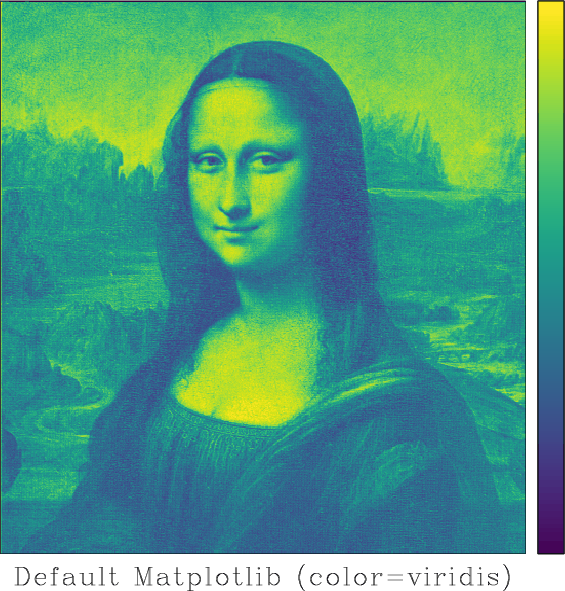
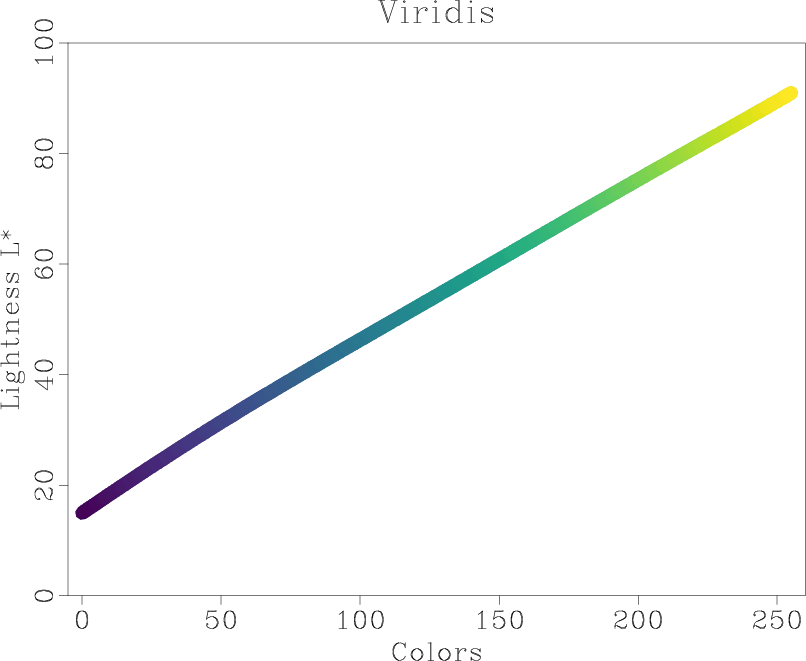
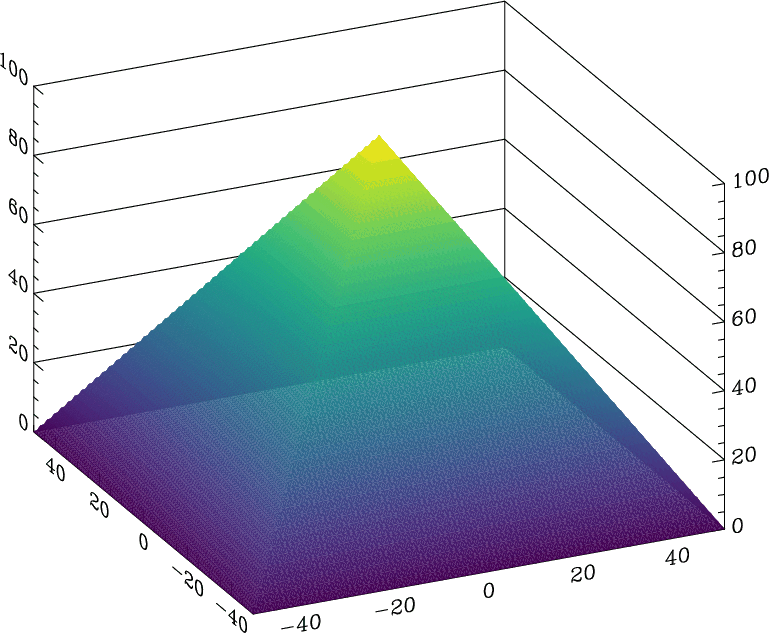
The most popular colormap in Madagascar, other than the default greyscale, is color=j, modeled after “jet“, which used to be the default colormap in MATLAB. More than 1,000 Madagascar examples use color=j. In October 2014, with release R2014b (Version 8.4), MATLAB switched the default colormap to a different one, called “parula“. The “parula” colormap is copyrighted by MathWorks as a result of a creative process (solving an optimization problem). No open-source license is given to use it outside of MATLAB. According to Steve Eddins, “this colormap is MathWorks intellectual property, and it would not be appropriate or acceptable to copy or re-use it in non-MathWorks plotting tools.” Stéfan van der Walt and Nathaniel Smith from the Berkeley Institute for Data Science have developed several new open-source colormaps with good perceptual properties. One of them (named “viridis“) is proposed as a good replacement for “jet” and as the default colormap in matplotlib 2.0. Is it a good colormap? We can find out by using tools from Matteo Niccoli’s tutorial on colormaps. This analysis shows the intensity and lightness distributions of “viridis” are nicely linear. In his presentation at SciPy-2015, Nathaniel Smith explains the rational for this choice.

Program of the month: sfmutter

July 10, 2015 Celebration No comments

sfmutter performs a mute operation, common in prestack seismic data processing.

The following example from bei/wvs/vscan shows a seismic CMP gather before and after a mute.
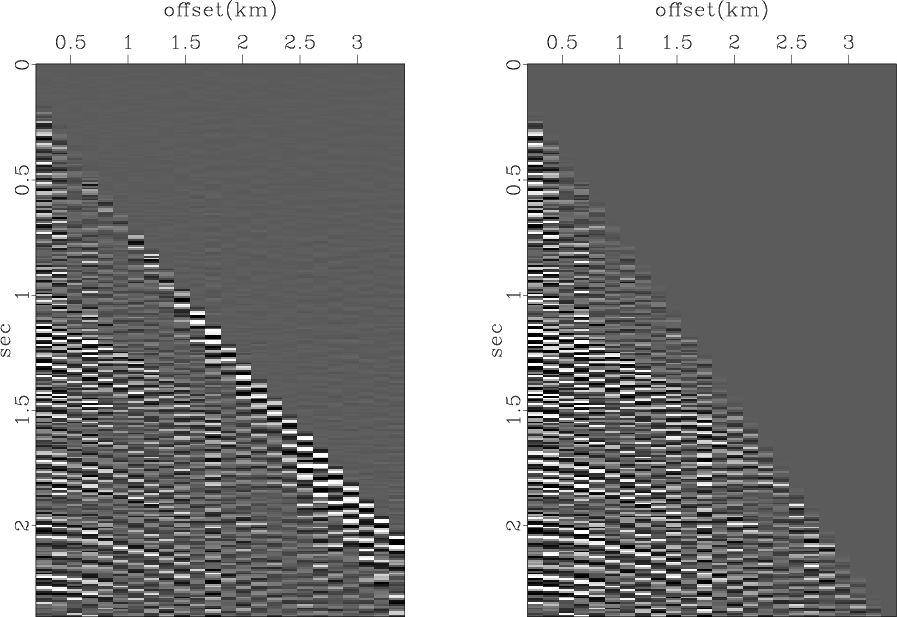
sfmutter multiples the input by a weight, which follows the equation

$$W(t,x) = \left\{\begin{array}{rl} 0 & \quad \mbox{for} \quad t – t_0 < p_0\,(x-x_0) \\ 1 & \quad \mbox{for} \quad t – t_0 > \Delta t + p_1\,(x-x_0) \end{array}\right.$$

The weight is smoothly interpolated in between the two regions. Different parameters appearing in this equation can be specified as inputs for sfmutter: t0= and x0= correspond to $t_0$ and $x_0$; tp= corresponds to $\Delta t$; slope0= and slopep= correspond to $p_0$ and $p_1$, respectively. The slope can be specified by velocity v0= such that $p_0=1/v_0$. By default, $p_1=p_0$.

The parameter half= indicates whether the horizontal axis corresponds to half-offset instead of the full offset (true by default). In case of irregular offsets, they can be provides in a file specified by offset=. The parameter abs= controls whether to use the absolute value of the offset in the calculation of the mute (true by default).

To make a hyperbolic mute, instead of the default linear mute, use hyper=y. In this case, the equation changes to

$$W(t,x) = \left\{\begin{array}{rl} 0 & \quad \mbox{for} \quad (t-t_0)^2 < p_0^2\,(x-x_0)^2 \\ 1 & \quad \mbox{for} \quad (t-t_0)^2 > (\Delta t)^2 + p_1^2\,(x-x_0)^2 \end{array}\right.$$

The following example from xjtu/mcaseislet/sep2 applies a hyperbolic mute for an SRME prediction of surface-related multiple reflections:

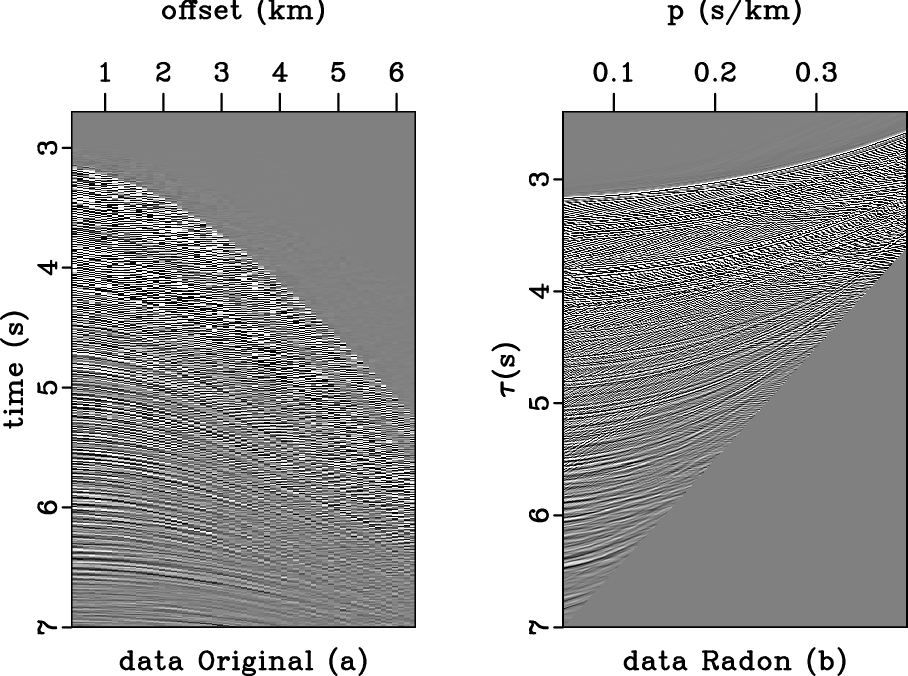
For inner mute, specified by inner=y, the signs in the equation are reversed. The following example from milano/taupvel/cmp applies an inner mute to a Radon-transformed CMP gather:
10 previous programs of the month:

Tutorial on seismic petrophysics, Part 1

July 8, 2015 Examples No comments

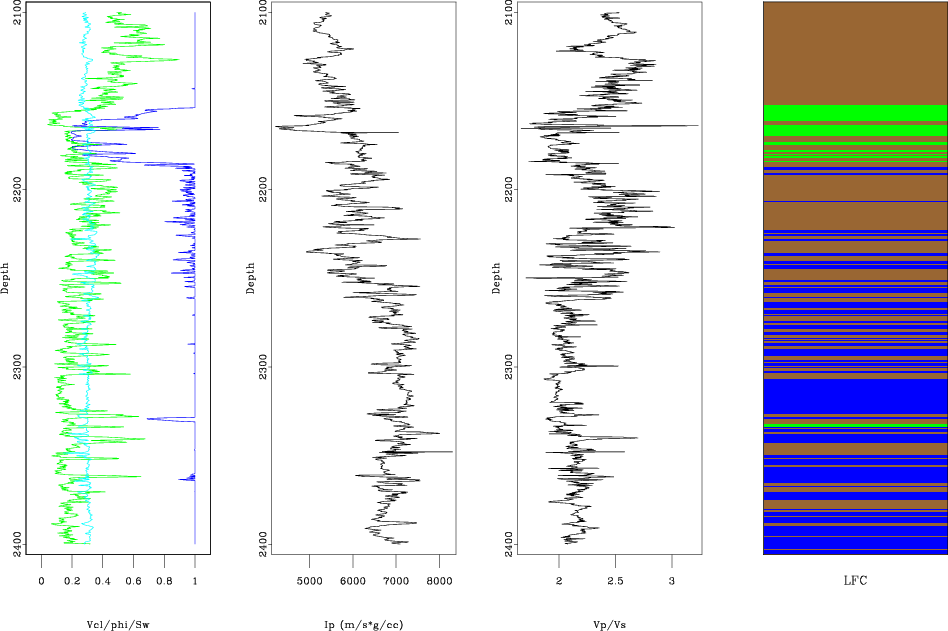
The example in rsf/tutorials/petro1 reproduces the tutorial from Alessandro Amato del Monte on seismic petrophysics (Part 1). The tutorial was published in the April 2015 issue of The Leading Edge.


Madagascar users are encouraged to try improving the results.

Tutorial on well-tie calculus

June 26, 2015 Examples No comments

The example in rsf/tutorials/well-tie reproduces the tutorial from Evan Bianco on well-tie calculus. The tutorial was published in the June 2014 issue of The Leading Edge.


Madagascar users are encouraged to try improving the results.

Similarity-weighted semblance

June 25, 2015 Documentation No comments

A new paper is added to the collection of reproducible documents:
Velocity analysis using similarity-weighted semblance

Weighted semblance can be used for improving the performance of the traditional semblance for specific datasets. We propose a novel approach for prestack velocity analysis using weighted semblance. The novelty comes from a different weighting criteria in which the local similarity between each trace and a reference trace is used. On one hand, low similarity corresponds to a noise point or a point indicating incorrect moveout, which should be given a small weight. On the other hand, high similarity corresponds to a point indicating correct moveout, which should be given a high weight. The proposed approach can also be effectively used for analyzing AVO anomalies with increased resolution compared with AB semblance. Both synthetic and field CMP gathers demonstrate higher resolution using the proposed approach. Applications of the proposed method on a prestack dataset further confirms that the stacked data using the similarity-weighted semblance can obtain better energy-focused events, which indicates a more precise velocity picking.

Test case for PEF estimation

June 24, 2015 Documentation No comments

Another old paper is added to the collection of reproducible documents:
Test case for PEF estimation with sparse data II

The two-stage missing data interpolation approach of Claerbout (1998) (henceforth, the GEE approach) has been applied with great success (Fomel et al., 1997; Clapp et al., 1998; Crawley, 2000) in the past. The main strength of the approach lies in the ability of the prediction error filter (PEF) to find multiple, hidden correlation in the known data, and then, via regularization, to impose the same correlation (covariance) onto the unknown model. Unfortunately, the GEE approach may break down in the face of very sparsely-distributed data, as the number of valid regression equations in the PEF estimation step may drop to zero. In this case, the most common approach is to simply retreat to regularizing with an isotropic differential filter (e.g., Laplacian), which leads to a minimum-energy solution and implicitly assumes an isotropic model covariance.
A pressing goal of many SEP researchers is to find a way of estimating a PEF from sparse data. Although new ideas are certainly required to solve this interesting problem, Claerbout (2000) proposes that a standard, simple test case first be constructed, and suggests using a known model with vanishing Gaussian curvature. In this paper, we present the following, simpler test case, which we feel makes for a better first step.

  • Model: Deconvolve a 2-D field of random numbers with a simple dip filter, leading to a “plane-wave” model.
  • Filter: The ideal interpolation filter is simply the dip filter used to create the model.
  • Data: Subsample the known model randomly and so sparsely as to make conventional PEF estimation impossible.

We use the aforementioned dip filter to regularize a least squares estimation of the missing model points and show that this filter is ideal, in the sense that the model residual is relatively small. Interestingly, we found that the characteristics of the true model and interpolation result depended strongly on the accuracy (dip spectrum localization) of the dip filter. We chose the 8-point truncated sinc filter presented by Fomel (2000). We discuss briefly the motivation for this choice.

Reproducible research and PDF files

June 21, 2015 Systems No comments

Claerbout’s principle of reproducible research, as formulated by Buckheit and Donoho (1995), states:

An article about computational science in a scientific publication is not the scholarship itself, it is merely advertising of the scholarship. The actual scholarship is the complete software development environment and the complete set of instructions which generated the figures.

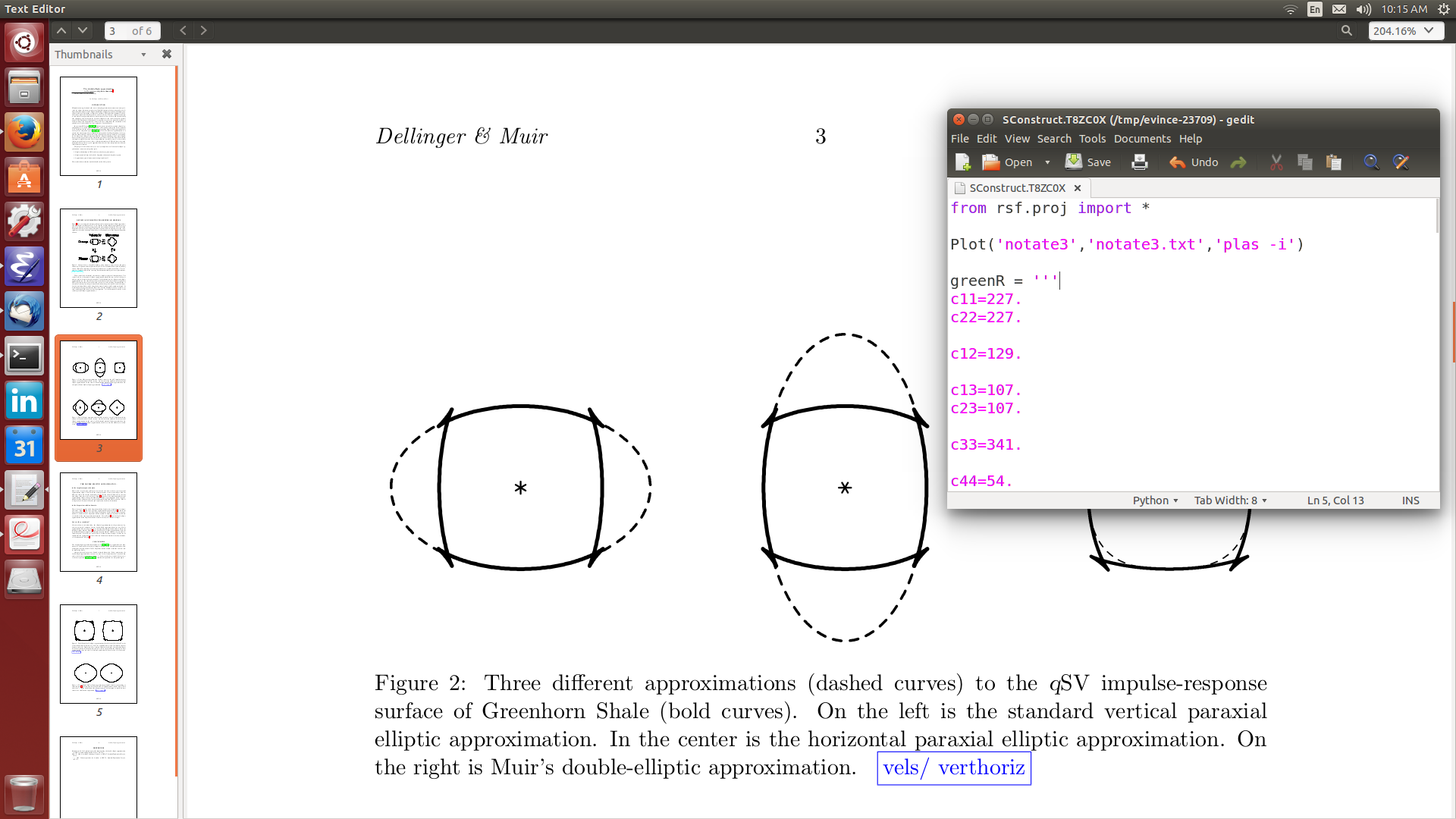
The geophysics class in the SEGTeX package features a new option: reproduce, which attaches SConstruct files or other appropriate code (Matlab scripts, Python scripts, etc.) directly to the PDF file of the paper, with a button under every reproducible figure for opening the corresponding script. Unfortunately, not every PDF viewer supports this kind of links. The screenshot below shows evince viewer on Linux, where clicking the button opens the file with gedit editor.

Double-elliptic approximation in TI media

June 16, 2015 Documentation No comments

Another old paper is added to the collection of reproducible documents:
The double-elliptic approximation in the group and phase domains

Elliptical anisotropy has found wide use as a simple approximation to transverse isotropy because of a unique symmetry property (an elliptical dispersion relation corresponds to an elliptical impulse response) and a simple relationship to standard geophysical techniques (hyperbolic moveout corresponds to elliptical wavefronts; NMO measures horizontal velocity, and time-to-depth conversion depends on vertical velocity). However, elliptical anisotropy is only useful as an approximation in certain restricted cases, such as when the underlying true anisotropy does not depart too far from ellipticity or the observed angular aperture is small. This limitation is fundamental, because there are only two parameters needed to define an ellipse: the horizontal and vertical velocities. (Sometimes the orientation of the principle axes is also included as a free parameter, but usually not.)
In a previous SEP report Muir (1990) showed how to extend the standard elliptical approximation to a so-called double-elliptic form. (The relation between the elastic constants of a TI medium and the coefficients of the corresponding double-elliptic approximation is developed in a companion paper, (Muir, 1991).) The aim of this new approximation is to preserve the useful properties of elliptical anisotropy while doubling the number of free parameters, thus allowing a much wider range of transversely isotropic media to be adequately fit. At first glance this goal seems unattainable: elliptical anisotropy is the most complex form of anisotropy possible with a simple analytical form in both the dispersion relation and impulse response domains. Muir’s approximation is useful because it nearly satisfies both incompatible goals at once: it has a simple relationship to NMO and true vertical and horizontal velocity, and to a good approximation it has the same simple analytical form in both domains of interest.
The purpose of this short note is to test by example how well the double-elliptic approximation comes to meeting these goals:

  1. Simple relationships to NMO and true velocities on principle axes.
  2. Simple analytical form for both the dispersion relation and impulse response.
  3. Approximates general transversely isotropic media well.

The results indicate that the method should work well in practice.