Separated qS-wave propagators

October 14, 2016 Documentation No comments

A new paper is added to the collection of reproducible documents: Simulating propagation of separated wave modes in general anisotropic media, Part II: qS-wave propagators
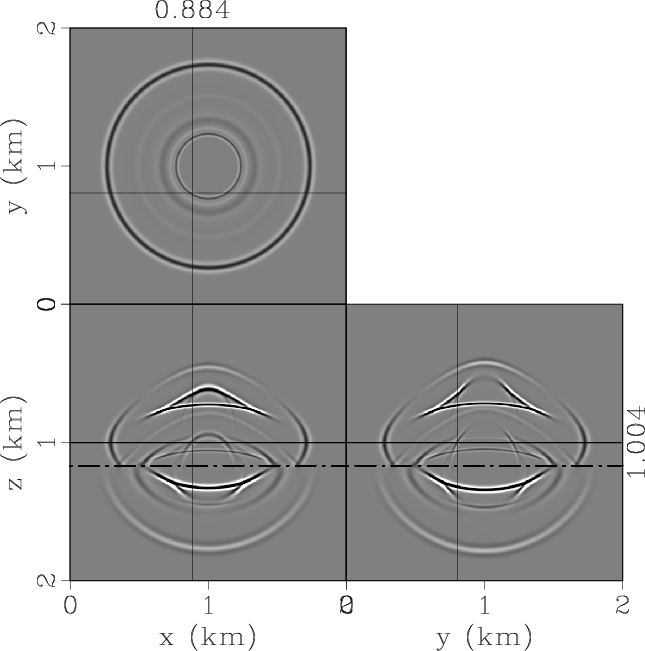
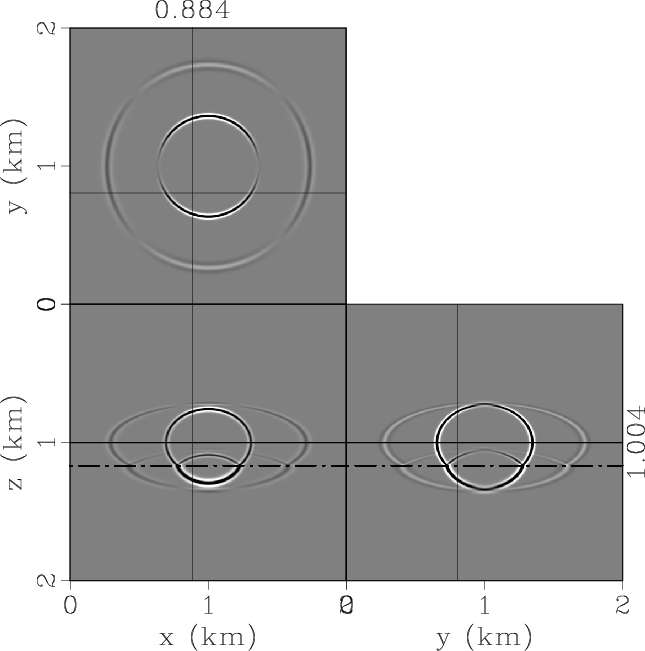
Shear waves, especially converted modes in multicomponent seismic data, provide significant information that allows better delineation of geological structures and characterization of petroleum reservoirs. Seismic imaging and inversion based upon the elastic wave equation involve high computational cost and many challenges in decoupling the wave modes and estimating so many model parameters. For transversely isotropic media, shear waves can be designated as pure SH and quasi-SV modes. Through two different similarity transformations to the Christoffel equation aiming to project the vector displacement wavefields onto the isotropic references of the polarization directions, we derive simplified second-order systems (i.e., pseudo-pure-mode wave equations) for SH- and qSV-waves, respectively. The first system propagates a vector wavefield with two horizontal components, of which the summation produces pure-mode scalar SH-wave data, while the second propagates a vector wavefield with a summed horizontal component and a vertical component, of which the final summation produces a scalar field dominated by qSV-waves in energy. The simulated SH- or qSV-wave has the same kinematics as its counterpart in the elastic wavefield. As explained in our previous paper (part I), we can obtain completely separated scalar qSV-wave fields after spatial filtering the pseudo-pure-mode qSV-wave fields. Synthetic examples demonstrate that these wave propagators provide efficient and flexible tools for qS-wave extrapolation in general transversely isotropic media.

US Presidential Candidates on Reproducible Research

September 13, 2016 Links No comments

Among other ideas and proposals, the 2016 US presidential candidates shared some thoughts on the issue of reproducible research in science.

Quoted from the traditional questionnaire in Scientific American, with emphasis added.

Hillary Clinton:

I believe federal policies can do even more to reinforce public trust in the integrity of science throughout the research enterprise. Though very rare, deliberate fraud in how scientists use public research dollars must be exposed, punished, and prevented. We can and will create further incentives to encourage scientists not only to maintain accountability and accuracy checks, but also to share data, code, and research results for reuse and support replication by others.

Donald Trump:

Science is science and facts are facts.

This is not a political endorsement. You can read the questionnaire to form your own opinion.

http://www.scientificamerican.com/article/what-do-the-presidential-candidates-know-about-science/

Program of the month: sflinear

March 23, 2016 Programs No comments

sflinear performs 1-D linear interpolation of irregularly spaced data.

The following example from rsf/su/rsflab4 shows a linearly interpolated velocity profile:

The input to sflinear contains coordinate-value pairs arranged so that the second dimension of the data is n2=2. The output contains regularly sampled values on the specified grid.

If the input coordinates are not in order and need sorting, use sort=y.

The output grid can be specified either by supplying it in a pattern file pattern= or by specifying the usual parameters n1=, o1=, d1=.

If the number of iterations specified by niter= is greater than zero, sflinear switches from simple linear interpolation to iterative interpolation by shaping regularization, which can produce a smooth output. The additional parameters to control this process are nw= (size of the local Lagrange interpolation filter for forward interpolation) and rect= (smoothing radius for shaping).

10 previous programs of the month:

Tutorial on semblance, coherence, and other discontinuity attributes

March 23, 2016 Examples No comments

The example in rsf/tutorials/semblance reproduces the tutorial from Joe Kington on semblance, coherence, and other discontinuity attributes. The tutorial was published in the December 2015 issue of The Leading Edge.

Madagascar users are encouraged to try improving the results.

Multiple realizations

March 17, 2016 Documentation No comments

Another old paper is added to the collection of reproducible documents: Multiple realizations using standard inversion techniques

When solving a missing data problem, geophysicists and geostatisticians have very similar strategies. Each use the known data to characterize the model’s covariance. At SEP we often characterize the covariance through Prediction Error Filters (PEFs) (Claerbout, 1998). Geostatisticians build variograms from the known data to represent the model’s covariance (Issaks and Srivastava, 1989). Once each has some measure of the model covariance they attempt to fill in the missing data. Here their goals slightly diverge. The geophysicist solves a global estimation problem and attempts to create a model whose covariance is equivalent to the covariance of the known data. The geostatistician performs kriging, solving a series of local estimation problem. Each model estimate is the linear combination of nearby data points that best fits their predetermined covariance estimate. Both of these approaches are in some ways exactly what we want: given a problem give me `the answer’…

Vplot figures and MS Word

March 16, 2016 Systems No comments

Joe Dellinger, the author of Vplot, suggests adjusting parameters for raster figures when including them in Word documents. He writes:

Wow, working on my SEG abstract I had a helluva time getting my vplot raster figures to look decent in word. Then I realized… wait a minute, it’s doing just the bad things plotters back in the 80’s were doing. I fiddled a little with pixc and greyc, and voila! Beautiful raster figures.

From the Vplot documentation:

  • pixc is used only when dithering is being performed, and also should only be used for hardcopy devices. It alters the grey scale to correct for pixel overlap on the device, which (if uncorrected) causes grey raster images to come out much darker on paper than on graphics displays.

  • greyc is used only when dithering is being performed, and really should only be used for hardcopy devices. It alters the grey scale so that grey rasters come out on paper with the same nonlinear appearance that is perceived on display devices.

The default values are pixc=1 greyc=1. The values used by Joe in his Word document were pixc=1.15 greyc=1.25.

To convert Vplot plots to other forms of graphics, you can use vpconvert.

See also:

National academies and reproducible research

March 14, 2016 Links No comments

A high-profile workshop Statistical Challenges in Assessing and Fostering the Reproducibility of Scientific Results was organized by the National Academies of Sciences and the National Science Foundation and took place in Washington (DC) last year. The workshop summary report was recently published by the National Academies Press.

Here is an extract, which lists recommendations from the panel discussion:

  • Establish publication requirements for open data and code. Journal editors and referees should confirm that data and code are linked and accessible before a paper is published. (Keith Baggerly)
  • Clarify strength of evidence for findings. The strength of evidence should be clearly stated for theories and results (in publications, press releases, etc.) to ensure that initial explorations are not misrepresented as being more conclusive than they actually are. (Keith Baggerly)
  • Align incentives. Communities need to examine how to build a culture that rewards researchers who put effort into verifying their own results rather than quickly rushing to publication (Marcia McNutt)
  • Improve training.
    • Institutions need to make extra efforts to instill students with an ethos of care and reproducibility. (Marcia McNutt)
    • Universities need to change the curriculum to incorporate topics such as version control, code review, and general data management, and communities need to revise their incentives to improve the chances of reproducible, trustworthy research in the future. Steps to improve the future workforce are necessary to keep the public trust of science. (Randy LeVeque)
    • Many graduates are well steeped in open-source software norms and ethics, and they are used to this as a normal way of operating. However, they come into a scientific research setting where codes are not shared, transparent, or open; instead, codes are being built or constructed in a way that feels haphazard to them. This training disconnect can interfere with mentorship and with their continuation in science. Better understanding of these norms is needed in all levels of research (Victoria Stodden)
    • Prevention and motivation need to be components of instilling the proper ethos. This could be part of National Institutes of Health (NIH)-mandated ethics courses. (Keith Baggerly)
  • Clarify terminology. A clearer set of terms is needed, especially for teaching students and creating guidelines and best practices. Some examples of how to do this can be found within the uncertainty quantification community, which successfully clarified the terms verification and validation that were almost used synonymously 10-15 years ago. (Ronald Boisvert)

The authors of these recommendations are:

Double-sparse dictionary

February 27, 2016 Documentation No comments

A new paper is added to the collection of reproducible documents: Double sparsity dictionary for seismic noise attenuation

A key step in sparsifying signals is the choice of a sparsity-promoting dictionary. There are two basic approaches to design such a dictionary: the analytic approach and the learning-based approach. While the analytic approach enjoys the advantage of high efficiency, it lacks adaptivity to various data patterns. On the other hand, the learning-based approach can adaptively sparsify different datasets but has a heavier computational complexity and involves no prior-constraint pattern information for particular data. We propose a double sparsity dictionary (DSD) for seismic data in order to combine the benefits of both approaches. We provide two models to learn the DSD: the synthesis model and the analysis model. The synthesis model learns DSD in the data domain, and the analysis model learns DSD in the model domain. We give an example of the analysis model and propose to use the seislet transform and data-driven tight frame (DDTF) as the base transform and adaptive dictionary respectively in the DSD framework. DDTF obtains an extra structure regularization by learning dictionaries, while the seislet transform obtains a compensation for the transformation error caused by slope dependency. The proposed DSD aims to provide a sparser representation than the individual transform and dictionary and therefore can help achieve better performance in denoising applications. Although for the purpose of compression, the proposed DSD is less sparse than the seislet transform, it outperforms both seislet and DDTF in distinguishing signal and noise. Two simulated synthetic examples and three field data examples confirm a better denoising performance of the proposed approach.

Continuous reproducibility using CircleCI

February 20, 2016 Systems No comments

Continuous Integration (CI) is a powerful discipline of software engineering, which involves a shared code repository, where developers contribute frequently (possibly several times per day), and an automated build system which includes testing scripts.

As previously suggested, CI tools can be easily adopted to perform continuous reproducibility: repeatedly testing if previously reproducible results remain reproducibe after software changes. Continuous reproducibility can assure that reproducible documents stay “alive” and continue to be usable.

Numerous tools have appeared in recent years to offer CI services in the cloud: Travis CI, Semaphore, Codeship, Shippable, etc. It is hard to choose one. I would pick CircleCI. CircleCI is developed by a startup company from San Francisco. Its product is not fundamentally different from analogous services but provides a solid implementation, which includes:

  • Integration with GitHub
  • SSH access
  • Sleek user interface
  • Simple configuration via circle.yml file
  • Fast parallel execution

Let us test if it can serve as a good platform for Madagascar’s continuous reproducibility.

Program of the month: sfmig2

February 18, 2016 Programs No comments

sfmig2 implements 2-D prestack Kirchhoff time migration.

The program is using triangle antialiasing filters.

J. F. Claerbout, 1992, Anti Aliasing: SEP-73, Stanford Exploration Project, 371-390.

D. E. Lumley, J. F. Claerbout, and D. Bevc, 1994, Anti-aliased Kirchhoff 3-D migration: SEG Annual Meeting, Expanded Abstracts, 1282-1285.

The following example from sep/aal/gulf shows migration applied to a near-offset section from the Gulf of Mexico.

The amount of antialiasing is controlled by antialias= parameter.

A half-derivative waveform-correction filter (rho filter) is applied and is controlled by rho= parameter.

The program has an adjoint flag adj= and can be used as a linear operator. The default value adj=y corresponds to migration, adj=n corresponds to modeling (demigration).

An additional required input is vel= (time-migration velocity). An optional output is gather= (common-offset image gathers).

10 previous programs of the month: