Analytical path-summation imaging

April 20, 2017 Documentation No comments

A new paper is added to the collection of reproducible documents: Analytical path-summation imaging of seismic diffractions

Diffraction imaging aims to emphasize small subsurface objects, such as faults, fracture swarms, channels, etc. Similarly to classical reflection imaging, velocity analysis is crucially important for accurate diffraction imaging. Path-summation migration provides an imaging method, which produces an image of the subsurface without picking a velocity model. Previous methods of path-summation imaging involve a discrete summation of the images corresponding to all possible migration velocity distributions within a predefined integration range and thus involve a significant computational cost. We propose a direct analytical formula for path-summation imaging based on the continuous integration of the images along the velocity dimension, which reduces the cost to that of only two fast Fourier transforms. The analytic approach also enables automatic migration velocity extraction from diffractions using double path-summation migration framework. Synthetic and field data examples confirm the efficiency of the proposed techniques.

3D generalized moveout approximation

April 20, 2017 Documentation No comments

A new paper is added to the collection of reproducible documents: 3D generalized nonhyperboloidal moveout approximation

Moveout approximations are commonly used in velocity analysis and time-domain seismic imaging. We revisit the previously proposed generalized nonhyperbolic moveout approximation and develop its extension to the 3D multi-azimuth case. The advantages of the generalized approximation are its high accuracy and its ability to reduce to several other known approximations with particular choices of parameters. The proposed 3D functional form involves seventeen independent parameters instead of five as in the 2D case. These parameters can be defined by zero-offset traveltime attributes and four additional far-offset rays. In our tests, the proposed approximation achieves significantly higher accuracy than previously proposed 3D approximations.

Program of the month: sfseislet

April 19, 2017 Programs No comments

sfseislet implements the 2-D seislet transform.

The seislet transform theory is descibed in the paper Seislet transform and seislet frame.

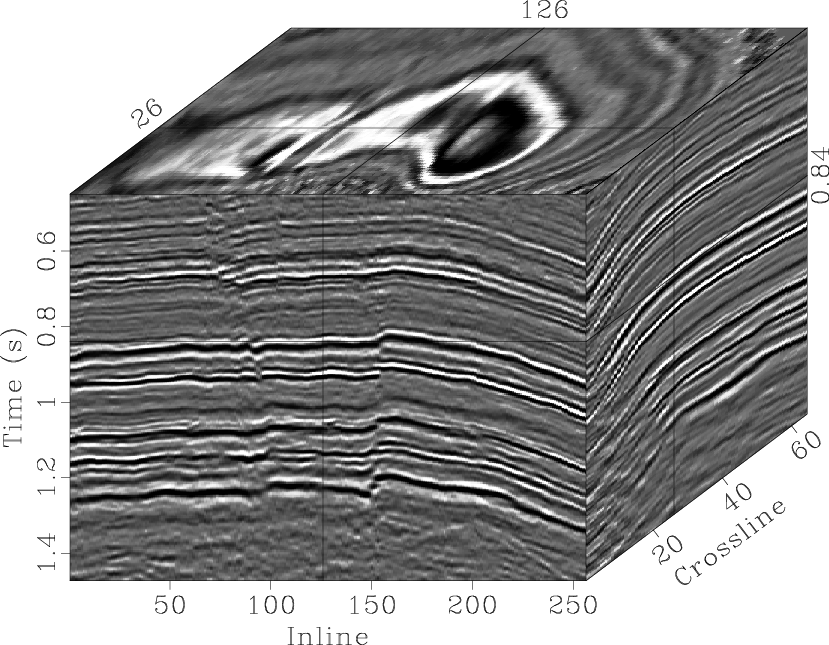
The following example from fpwd/teapot shows a 3-D seismic image before and after a seislet transform in the inline direction.

To perform the forward seislet transform, run sfseislet with the flag adj=y. To run the inverse transform, use adj=n. In a confusing choice of parameter names, inv= does not control the direction of the transform but the type of the weighting function used. Another control is provided by unit=.

A required auxiliary input is the dip field specified by dip=. If the dip was estimated using plane-wave destruction (sfdip), the order= parameter should be the same.

Different types of the seislet transform (specified by type=) correspond to different types of the corresponding digital wavelet transform. The choices are haar, linear, and biorthogonal.

10 previous programs of the month:

Elastic wave-vector decomposition

April 18, 2017 Celebration No comments

A new paper is added to the collection of reproducible documents: Elastic wave-vector decomposition in heterogeneous anisotropic media

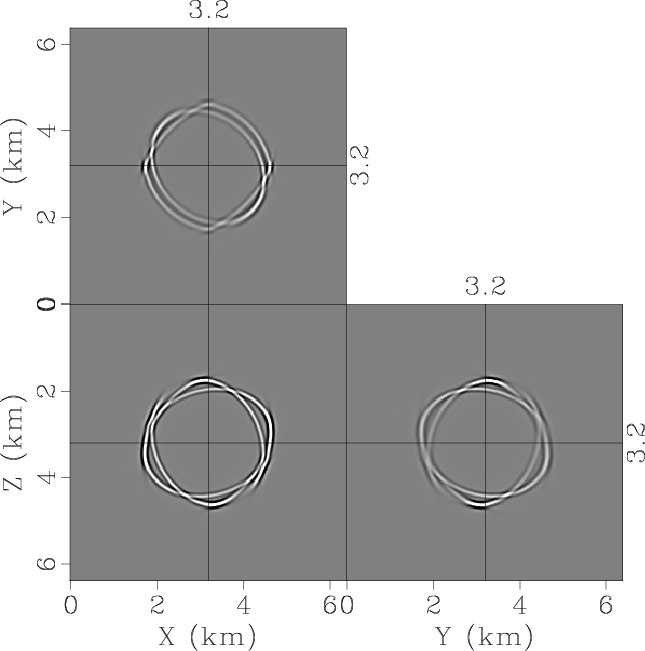
The goal of wave-mode separation and wave-vector decomposition is to separate full elastic wavefield into three wavefields with each corresponding to a different wave mode. This allows elastic reverse-time migration to handle of each wave mode independently . Several of the previously proposed methods to accomplish this task require the knowledge of the polarization vectors of all three wave modes in a given anisotropic medium. We propose a wave-vector decomposition method where the wavefield is decomposed in the wavenumber domain via the analytical decomposition operator with improved computational efficiency using low-rank approximations. The method is applicable for general heterogeneous anisotropic media. To apply the proposed method in low-symmetry anisotropic media such as orthorhombic, monoclinic, and triclinic, we define the two S modes by sorting them based on their phase velocities (S1 and S2), which are defined everywhere except at the singularities. The singularities can be located using an analytical condition derived from the exact phase-velocity expressions for S waves. This condition defines a weight function, which can be applied to attenuate the planar artifacts caused by the local discontinuity of polarization vectors at the singularities. The amplitude information lost because of weighting can be recovered using the technique of local signal-noise orthogonalization. Numerical examples show that the proposed approach provides an effective decomposition method for all wave modes in heterogeneous, strongly anisotropic media.

Interval traveltime parameter estimation

April 14, 2017 Documentation No comments

A new paper is added to the collection of reproducible documents: Theory of interval traveltime parameter estimation in layered anisotropic media

Moveout approximations for reflection traveltimes are typically based on a truncated Taylor expansion of traveltime squared around zero offset. The fourth-order Taylor expansion involves NMO velocities and quartic coefficients. We derive general expressions for layer-stripping both second- and fourth-order parameters in horizontally-layered anisotropic strata and specify them for two important cases: horizontally stacked aligned orthorhombic layers and azimuthally rotated orthorhombic layers. In the first of these cases, the formula involving the out-of-symmetry-plane quartic coefficients has a simple functional form and possesses some similarity to the previously known formulas corresponding to the 2D in-symmetry-plane counterparts in VTI media. The error of approximating effective parameters by using approximate VTI formulas can be significant in comparison with the exact formulas derived in this paper. We propose a framework for deriving Dix-type inversion formulas for interval parameter estimation from traveltime expansion coefficients both in the general case and in the specific case of aligned orthorhombic layers. The averaging formulas for calculation of effective parameters and the layer-stripping formulas for interval parameter estimation are readily applicable to 3D seismic reflection processing in layered anisotropic media.

AB semblance + local similarity stacking

January 18, 2017 Documentation No comments

A new paper is added to the collection of reproducible documents: Weighted stacking of seismic AVO data using hybrid AB semblance and local similarity

Common-midpoint (CMP) stacking technique plays an important role in enhancing the signal-to-noise ratio (SNR) in seismic data processing and imaging. Weighted stacking is often used to improve the performance of conventional equal-weight stacking in further attenuating random noise and handling the amplitude variations in real seismic data. In this study, we propose to use a hybrid framework of combining AB semblance and local-similarity-weighted stacking scheme. The objective is to achieve an optimal stacking of the CMP gathers with class II amplitude-variation-with-offset (AVO) polarity-reversal anomaly. The selection of high-quality near-offset reference trace is another innovation of this work because of its better preservation of useful energy. Applications to synthetic and field seismic data demonstrate a great improvement using our method to capture the true locations of weak reflections, distinguish thin-bed tuning artifacts, and effectively attenuate random noise.

This paper is the first direct contribution from the University of Houston.

Geophysics Papers of the Future

December 9, 2016 Links No comments

The race is on! Although the official (December 1) deadline has passed, papers continue to be accepted for the special section Reproducible research: Geophysics papers of the future in Geophysics. As long as the paper can be reviewed in time for the desiugnated issue (November-December 2017), it will be accepted for the special section. Otherwise, it will appear in a regular issue of the journal.

If you use Madagascar to prepare your “paper of the future”, you can commit the code to the Madagascar repository and add a link to your submission. Alternatively, the code can be submitted as an attachment.

The concept of reproducible research, pioneered 25 years ago by Jon Claerbout, suggests the discipline of of attaching software code and data to scientific publications in order to enable the reader to verify, reproduce, and extend computational experiments described in the publication. A framework for reproducible research is provided by the Madagascar open-source software project, which was started 10 years ago. This special section will collect papers on different subjects in exploration geophysics united
by the discipline of reproducible research. Each paper in the section will be reviewed according to the guidelines of the Geophysics Software & Algorithms section, which means that not only the text of the paper but also its associated software codes will be examined by the reviewers, and the reproducibility of computational experiments will be independently verified. For more information, visit http://software.seg.org.

The recent Geoscience Papers of the Future (GPF) Initiative qualifies papers in the special section as Geophysics papers of the future. Supported by the National Science Foundation, “GPF is an initiative to encourage geoscientists to publish papers together with the associated digital products of their research. This means that a paper would include: 1) Documentation of data sets, including descriptions, unique identifiers, and availability in public repositories; 2) Documentation of software, including preprocessing
of data and visualization steps, described with metadata and with unique identifiers and pointers to public code repositories; [and] 3) Documentation of the provenance and workflow for each figure or result.” For more information, visit http://www.ontosoft.org/gpf/.

Use of the Madagascar framework is encouraged but not required, as long as the submitted paper satisfies the reproducibility conditions. Use of proprietary data is allowed as long as it is restricted to one section of the paper while other parts of the paper use publicly available or synthetically generated data.

Propagating decoupled elastic waves using low-rank approximation

November 21, 2016 Celebration No comments

A new paper is added to the collection of reproducible documents: Simulating propagation of decoupled elastic waves using low-rank approximate mixed-domain integral operators for anisotropic media

In elastic imaging, the extrapolated vector fields are decoupled into pure wave modes, such that the imaging condition produces interpretable images. Conventionally, mode decoupling in anisotropic media is costly as the operators involved are dependent on the velocity, and thus are not stationary. We develop an efficient pseudo-spectral approach to directly extrapolate the decoupled elastic waves using low-rank approximate mixed-domain integral operators on the basis of the elastic displacement wave equation. We apply k-space adjustment to the pseudo-spectral solution to allow for a relatively large extrapolation time-step. The low-rank approximation is, thus, applied to the spectral operators that simultaneously extrapolate and decompose the elastic wavefields. Synthetic examples on transversely isotropic and orthorhombic models show that, our approach has the potential to efficiently and accurately simulate the propagations of the decoupled quasi-P and quasi-S modes as well as the total wavefields, for elastic wave modeling, imaging and inversion.

Lowrank one-step wave extrapolation

November 17, 2016 Documentation No comments

A new paper is added to the collection of reproducible documents: Lowrank one-step wave extrapolation for reverse-time migration

Reverse-time migration (RTM) relies on accurate wave extrapolation engines to image complex subsurface structures. To construct such operators with high efficiency and numerical stability, we propose an approach of one-step wave extrapolation using complex-valued lowrank decomposition to approximate the mixed-domain space-wavenumber wave extrapolation symbol. The lowrank one-step method involves a complex-valued phase function, which is more flexible than a real-valued phase function of two-step schemes, and thus is capable of modeling a wider variety of dispersion relations. Two novel designs of the phase function lead to desired properties in wave extrapolation. First, for wave propagation in inhomogeneous media, we include a velocity gradient term to implement a more accurate phase behavior, particularly when velocity variations are large. Second, we develop an absorbing boundary condition, which is propagation-direction-dependent and can be incorporated into the phase function as an anisotropic attenuation term. This term allows waves to travel parallel to the boundary without absorption, thus reducing artificial reflections at wide-incident angles. Using numerical experiments, we demonstrate the stability improvement of a one-step scheme in comparison with two-step schemes. We observe the lowrank one-step operator to be remarkably stable and capable of propagating waves using large time step sizes, even beyond the Nyquist limit. The stability property can help minimize the computational cost of seismic modeling or reverse-time migration. We also demonstrate that lowrank one-step wave extrapolation handles anisotropic wave propagation accurately and efficiently. When applied to RTM in anisotropic media, the proposed method generates high quality images.

Madagascar School in Zürich

October 31, 2016 Celebration No comments

Filippo Broggini reports:

The 2016 Madagascar School on Reproducible Computational Geophysics took place in Zürich, Switzerland, on June 6-7, 2016, and was hosted by the Exploration and Environmental Geophysics (EEG) group at ETH Zürich.

The school attracted more than 15 participants from 5 countries and 10 different universities. The program included lectures given by 5 different instructors and hands-on exercises on different topics in the use of the Madagascar software framework. The school materials are available on the website.