A Madagascar school will take place on January 7-8, 2015, in Harbin, China, and will be hosted by the Harbin Institute of Technology (HIT) in conjunction with the International Workshop on Mathematical Geophysics.

More information will be available soon on the school webpage.
Madagascar school in Harbin
November 13, 2014 Celebration No comments
Second Madagascar Working Workshop
August 5, 2014 Celebration No comments
“Working workshops” as opposed to “talking workshops” are meetings where the participants work together (possibly divided into pairs or small teams) to develop new software code or to conduct computational experiments addressing a particular problem. Working workshops are a cross between scientific workshops and coding sprints or hackathons common among open-source software communities.

26 participants from 11 different organizations gathered at Rice University at the end of July and beginning of August for the Second Madagascar Working Workshop, hosted by The Rice Inversion Project. The topic of the workshop was parallel high-performance computing. The participants divided into teams of 2-3 people by pairing experienced Madagascar developers with novice users. Each team worked on a small project, creating examples of parallel computing or improving general-purpose tools such as sfmpi, sfomp, and (newly created) sfbatch.

The participants used Stampede, the world’s seventh most powerful supercomputer, provided by the Texas Advanced Computing Center, for their computational experiments.
Second working workshop
June 1, 2014 Celebration 2 comments
Registration is open for Madagascar’s Second Working Workshop.

As a reminder, Working Workshops as opposed to “talking workshops” are meetings where the participants work together (possibly divided into pairs or small teams) to develop new software code or to conduct computational experiments addressing a particular problem. The First Working Workshop took place last summer in Austin. This year’s workshop will take place on at Rice University in Houston, Texas, on July 31 – August 2, 2014. The topic of this year’s workshop is parallel and high-performance computing. The objective is
- To develop convenient tools for high-performance and parallel computing.
- To create new examples of distributed-memory and shared-memory parallel computing.
- To explore hardware-accelerated parallel computing (NVIDIA GPU and Intel® Xeon Phi).
Registration is free by an application is required. If you are interested in participating in this workshop, please fill an application form.
madagascar-1.6 released
May 9, 2014 Celebration No comments
The 1.6 stable release features fifteen new reproducible papers and multiple other enhancements including the addition of the seismic migration gallery.
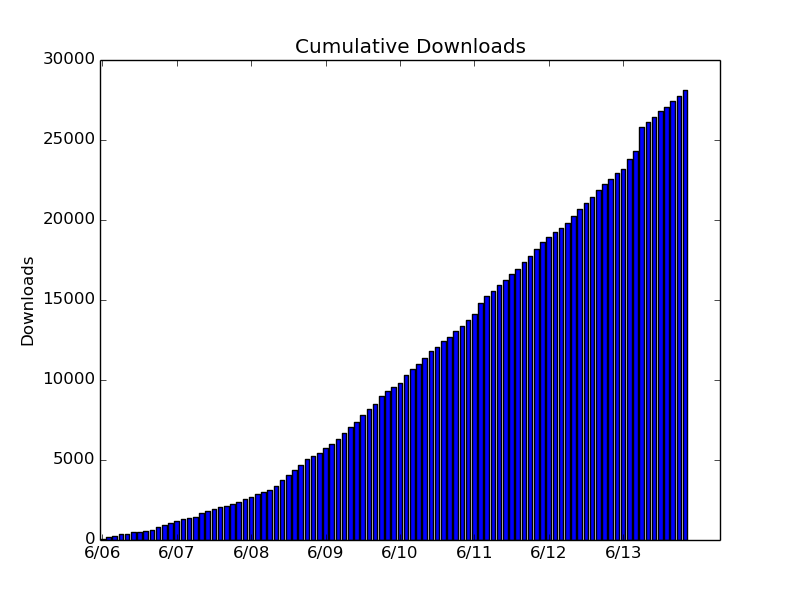
According to the SourceForge statistics, the previous 1.5 stable distribution has been downloaded more than 5,000 times. The record number of downloads in September 2013 is probably due to the fact that Madagascar is being used for teaching at different universities. The top country (with 40% of all downloads) was China, followed by the US, Brazil, Mexico, and Australia.
According to Ohloh.net, the year before the 1.6 release was the period of a high development activity, with 41 contributors (up 41% compared to the previous year) making 1,762 commits to the repository. Ohloh.net says that Madagascar “has a well established, mature codebase maintained by a very large development team with stable year-over-year commits” and estimated 201 man-years of effort.

Madagascar school in St. Petersburg
February 11, 2014 Celebration No comments
A Madagascar school will take place on April 11, 2014, in St. Petersburg, Russia, at a workshop during the EAGE convention. The workshop was proposed by Paul Sava.

See the workshop page for more information.
Madagascar school in Melbourne
August 25, 2013 Celebration No comments
Australia’s population is smaller than the population of Texas, yet Australia’s surface area is more than ten times larger than Texas. Australia is not only one of the top ten countries by proven natural gas reserves (the full list is Iran, Russia, Qatar, Turkmenistan, USA, Saudi Arabia, Venezuela, Nigeria, Algeria, Australia) but also one of the top ten countries in visits to the Madagascar website (the full list is USA, China, Canada, UK, Brazil, Germany, India, Saudi Arabia, France, Australia).

The Madagascar school in Melbourne, Australia, took place on August 15 and was organized by Jeff Shragge from UWA as a workshop at the 2013 ASEG-PESA meeting. The school attracted nearly 20 participants who listened to presentations and worked through interactive exercises. Jan Stellingwerff from dGB demonstrated the Madagascar interface in OpendTect. The school materials are available now on the website.
First Working Workshop
July 28, 2013 Celebration 2 comments
 An unusual experiment in collaborative reproducible research took place in Austin, Texas, on July 25-27: 25 participants from 9 different organizations gathered at the Bureau of Economic Geology, The University of Texas at Austin for the First Madagascar Working Workshop. The participants divided into 10 teams of 2-3 people by pairing experienced Madagascar developers with novice users. Each team worked on a small project, updating either reproducible papers or entries in the migration gallery. At the conclusion of the meeting, the participants discussed their experience and plans for future workshops.
madagascar-1.5 released
July 24, 2013 Celebration No comments
The 1.5 stable release features nine new reproducible papers and multiple other enhancements including the addition of the RVL (Rice Vector Library) and IWAVE++ full waveform inversion packages from Bill Symes and The Rice Inversion Project.
According to the SourceForge statistics, the previous 1.4 stable distribution has been downloaded more than 3,000 times. The total number of Madagascar downloads is approaching 25,000. According to Ohloh.net,, the year before 1.5 release was the period of a record development activity, with 32 contributors (up 33% compared to the previous year) making 1,570 commits to the repository (up 35%). Ohloh.net says that Madagascar “has a well established, mature codebase maintained by a very large development team with increasing year-over-year commits” and estimated 167 man-years of effort.

Events of the year
May 2, 2013 Celebration No comments
A Madagascar School will take place on August 15, 2013, in Melbourne, Australia, during the ASEG convention and is organized by Jeff Shragge from the University of Western Australia.

In addition, the First Madagascar Working Workshop will take place on July 25-27, 2013, in Austin, Texas. The declared objectives of the workshop are
- To expand Madagascar’s collection of reproducible papers. New reproducible papers may include papers written using Madagascar programs as well as papers written using other open-source software tools.
- To create and expand a seismic migration gallery. Migration gallery is a matrix where rows are different benchmark datasets and columns are different seismic migration algorithms.
If you are interested in participating in this event, please apply for a registration by following the link at https://www.ahay.org/wiki/Austin_2013. The application deadline is July 1.
IPython
March 30, 2013 Celebration No comments
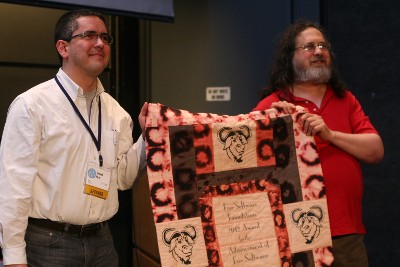
On March 23, Fernando Perez, the creator of IPython, received the Award for the Advancement of Free Software. The award was presented by Richard Stallman, the president of the Free Software Foundation, at a ceremony in Cambridge, Massachusetts.
IPython plays well with Madagascar through the use of the Python interface. A particularly convenient way of using IPython’s interactive capabilities is the web-based notebook interface.

We can expect new enhancements to IPython’s notebook interface from Fernando Perez and his collaborators thanks to a generous grant from the Sloan foundation.