![[pdf]](icons/pdf.png)
|
|
|
|
| Diffraction imaging and time-migration velocity analysis using oriented velocity continuation | |
|
Slope gathers, analogous to dip-angle gathers, can be
extracted before stacking over slope by analyzing  panels for different
image locations
panels for different
image locations  and velocities
  . Measuring flatness of
diffraction events in these gathers provides a means for
estimating migration velocity (Landa et al., 2008; Reshef and Landa, 2009).
. Measuring flatness of
diffraction events in these gathers provides a means for
estimating migration velocity (Landa et al., 2008; Reshef and Landa, 2009).
For practical implementation, the formulation of oriented velocity
continuation can be simplified by employing a stretch from the regular
time coordinate to squared time
 (Fomel, 2003b). According to this
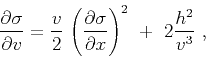
transformation, the Hamilton-Jacobi equation (1) becomes
(Fomel, 2003b). According to this
transformation, the Hamilton-Jacobi equation (1) becomes
 corresponds to
 , and the image is
constructed in
, and the image is
constructed in
 coordinates instead of
  coordinates. Applying the Fourier transform, we
can further transform equation (10) to
coordinates. Applying the Fourier transform, we
can further transform equation (10) to
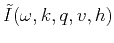 is the double Fourier transform of
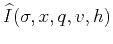 in
in  and .
Equation (11) has the analytical solution:
and .
Equation (11) has the analytical solution:
 is a constant non-zero initial migration velocity.
Stacking over offset provides a slope-decomposed formulation for oriented velocity continuation:
This derivation suggests the following algorithm for time-domain imaging using common-offset 2D oriented velocity continuation:
to generate  .
.
 to .
to
to .
to  .
.
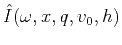 . Note that this operation is parallel in and
  .
to
.
to  to generate
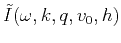 . Note that this operation is parallel in and .
for multiple values of . Note that this operation is data-intensive but parallel in , , and .
. Note that this operation is parallel in and .
for multiple values of . Note that this operation is data-intensive but parallel in , , and .
 .
.
 .
to .
and extract the slice at time-migration velocity
.
to .
and extract the slice at time-migration velocity  to generate the final time-migrated image
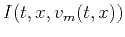 .
.
In order to estimate the velocity , we apply the workflow
described above to diffraction imaging and modify it as follows:
 and automatically pick the velocity that corresponds to the maximum flatness (semblance) over using the picking algorithm described by Fomel (2009b). This approach follows the principle of flatness of diffraction events in slope gathers (Landa et al., 2008; Reshef and Landa, 2009; Klokov and Fomel, 2012).
The computational cost associated with determining velocity using oriented velocity continuation is linear with the number of time samples, spatial samples, offsets, velocities, and slopes considered. It is parallel in spatial samples, offsets, velocity, and slope. The cost may then be considered as
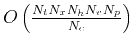 where
where  is the number of cores available.
|
|
|
|
| Diffraction imaging and time-migration velocity analysis using oriented velocity continuation | |
|