velocities in
transversally isotropic media
velocities in
transversally isotropic media
![[pdf]](icons/pdf.png)
|
|
|
|
| On anelliptic approximations for
velocities in
transversally isotropic media | |
|
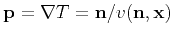
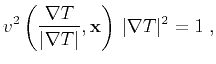
Wavefront propagation in the general anisotropic media can be described with the anisotropic eikonal equation
 is a point in space,
 is the
traveltime at that point for a given source, and
is the
traveltime at that point for a given source, and
 is the phase velocity in the phase direction
 .
.
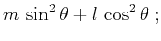
In the case of VTI media, the three modes of elastic wave propagation
( ,
,  , and
) have the following well-known explicit
expressions for the phase velocities (Gassmann, 1964):
, and
) have the following well-known explicit
expressions for the phase velocities (Gassmann, 1964):
 ,
,  ,
,  ,
,  ,
,  ,
,
 are the density-normalized components of the elastic tensor, and
  is
the phase angle between the phase direction
is
the phase angle between the phase direction
 and the axis of
symmetry.
and the axis of
symmetry.
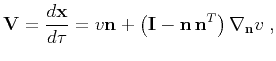
The group velocity describes the propagation of individual ray trajectories
 . It can be determined from the phase velocity using the
general expression
. It can be determined from the phase velocity using the
general expression
 denotes the identity matrix,
 stands for the
transpose of
, and
stands for the
transpose of
, and
 is the gradient
of
is the gradient
of  with respect to
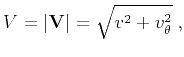
. The two terms in
equation (5) are clearly orthogonal to each other. Therefore, the
group velocity magnitude is
(Berryman, 1979; Byun, 1984; Postma, 1955)
with respect to
. The two terms in
equation (5) are clearly orthogonal to each other. Therefore, the
group velocity magnitude is
(Berryman, 1979; Byun, 1984; Postma, 1955)
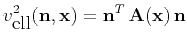
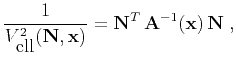
The group velocity has a particularly simple form in the case of elliptic anisotropy. Specifically, the phase velocity squared has the quadratic form
 , and the group
velocity is
, and the group
velocity is
 .
The corresponding group slowness squared has the explicit expression
.
The corresponding group slowness squared has the explicit expression
 is the group direction, and
 is the matrix
inverse of
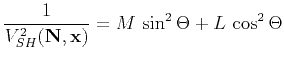
. For example, the elliptic expression (2) for
the phase velocity of
waves in VTI media transforms into a completely
analogous expression for the group slowness
is the matrix
inverse of
. For example, the elliptic expression (2) for
the phase velocity of
waves in VTI media transforms into a completely
analogous expression for the group slowness
 ,
,  , and
, and  is the angle between the group direction
and the axis of symmetry.
is the angle between the group direction
and the axis of symmetry.
The situation is more complicated in the anelliptic case.
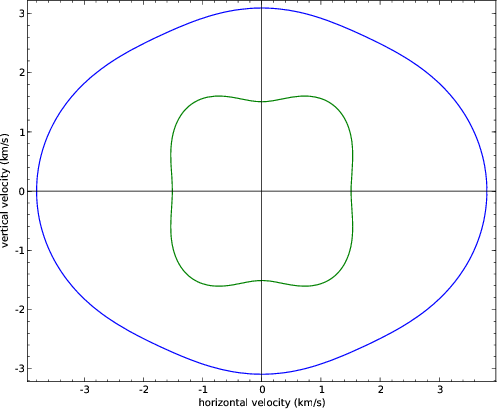
Figure 1 shows the
and
phase velocity profiles in a
transversely isotropic material - Greenhorn shale (Jones and Wang, 1981),
which has the parameters
 km
km s
s ,
,
 kms
,
kms
,
 kms
, and
kms
, and
 kms
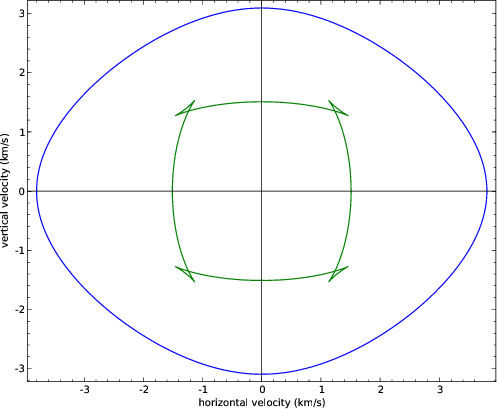
. Figure 2 shows the
corresponding group velocity profiles. The non-convexity of the
phase
velocity causes a multi-valued (triplicated) group velocity profile. The
shapes of all the surfaces are clearly anelliptic.
kms
. Figure 2 shows the
corresponding group velocity profiles. The non-convexity of the
phase
velocity causes a multi-valued (triplicated) group velocity profile. The
shapes of all the surfaces are clearly anelliptic.
|
|---|
|
exph
Figure 1. Phase velocity profiles for
(outer curve) and
(inner curve) waves in a transversely isotropic material (Greenhorn
shale).
|
![[sage]](icons/sage.png)
|
|
|---|
|
exgr
Figure 2. Group velocity profiles for
(outer curve) and
(inner curve) waves in a transversely isotropic material (Greenhorn
shale).
|
|
|
A simple model of anellipticity is suggested by the Muir approximation (Dellinger et al., 1993; Muir and Dellinger, 1985), reviewed in the next section.
|
|
|
|
| On anelliptic approximations for
velocities in
transversally isotropic media | |
|



![$\displaystyle \frac{1}{2}\,\left[(a+l)\,\sin^2{\theta} + (c+l)\,\cos^2{\theta}\right] -$](img15.png)
![$\displaystyle \frac{1}{2}\,\sqrt{\left[(a-l)\,\sin^2{\theta} -
(c-l)\,\cos^2{\theta}\right]^2 +
4\,(f+l)^2\,\sin^2{\theta}\,\cos^2{\theta}}\;;$](img16.png)

![$\displaystyle \frac{1}{2}\,\left[(a+l)\,\sin^2{\theta} + (c+l)\,\cos^2{\theta}\right] +$](img18.png)
![$\displaystyle \frac{1}{2}\,\sqrt{\left[(a-l)\,\sin^2{\theta} - (c-l)\,\cos^2{\theta}\right]^2 +
4\,(f+l)^2\,\sin^2{\theta}\,\cos^2{\theta}}\;,$](img19.png)