![[pdf]](icons/pdf.png)
|
|
|
|
| Homework 2 | |
|
|
time
Figure 4. Traveltime in a  medium. medium.
|

|
|---|---|
![[scons]](icons/configure.png)
|
The program cmp/traveltime.c computes reflection traveltimes
in a medium by using different methods.
 for a given
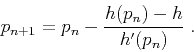
  by solving the non-linear equation
  with iterations
/* Compute traveltime in a V(z) model. */
#include <rsf.h>

int main(int argc, char* argv[])
{
    char *type;
    int ih, nh, it, nt, ir, nr, *r, iter, niter;
    float h, dh, h0, dt, t0, t2, h2, v2, s, p, hp, tp;
    float *v, *t;
    sf_file vel, tim;

    /* initialize */
    sf_init(argc,argv);

    /* input and output */
    vel = sf_input("in");
    tim = sf_output("out");

    /* time axis from input */
    if (!sf_histint(vel,"n1",&nt)) sf_error("No n1=");
    if (!sf_histfloat(vel,"d1",&dt)) sf_error("No d1=");

    /* offset axis from command line */
    if (!sf_getint("nh",&nh)) nh=1;
    /* number of offsets */
    if (!sf_getfloat("dh",&dh)) dh=0.01;
    /* offset sampling */
    if (!sf_getfloat("h0",&h0)) h0=0.0;
    /* first offset */

    /* get reflectors */
    if (!sf_getint("nr",&nr)) nr=1;
    /* number of reflectors */
    r = sf_intalloc(nr);
    if (!sf_getints("r",r,nr)) sf_error("Need r=");

    if (NULL == (type = sf_getstring("type")))
	type = "hyperbolic";
    /* traveltime computation type */

    if (!sf_getint("niter",&niter)) niter=10;
    /* maximum number of shooting iterations */

    /* put dimensions in output */
    sf_putint(tim,"n1",nh);
    sf_putfloat(tim,"d1",dh);
    sf_putfloat(tim,"o1",h0);
    sf_putint(tim,"n2",nr);

    /* read velocity */
    v = sf_floatalloc(nt);
    sf_floatread(v,nt,vel);
    /* convert to velocity squared */
    for (it=0; it < nt; it++) {
	v[it] *= v[it];
    }

    t = sf_floatalloc(nh);

    for (ir=0; ir<nr; ir++) {
	nt = r[ir];
	t0 = nt*dt; /* zero-offset time */
	t2 = t0*t0;

	p = 0.0;

	for (ih=0; ih<nh; ih++) {
	    h = h0+ih*dh; /* offset */
	    h2 = h*h;

	    switch(type[0]) {
		case 'h': /* hyperbolic approximation */
		    v2 = 0.0;
		    for (it=0; it < nt; it++) {
			v2 += v[it];
		    }
		    v2 /= nt;

		    t[ih] = sqrtf(t2+h2/v2);
		    break;
		case 's': /* shifted hyperbola */

		    /* !!! MODIFY BELOW !!! */

		    s = 0.0;

		    v2 = 0.0;
		    for (it=0; it < nt; it++) {
			v2 += v[it];
		    }
		    v2 /= nt;

		    t[ih] = sqrtf(t2+h2/v2);
		    break;
		case 'e': /* exact */

		    /* !!! MODIFY BELOW !!! */

		    for (iter=0; iter < niter; iter++) {
			hp = 0.0;
			for (it=0; it < nt; it++) {
			    v2 = v[it];
			    hp += v2/sqrtf(1.0-p*p*v2);
			}
			hp *= p*dt;

			/* !!! SOLVE h(p)=h !!! */
		    }

		    tp = 0.0;
		    for (it=0; it < nt; it++) {
			v2 = v[it];
			tp += dt/sqrtf(1.0-p*p*v2);
		    }

		    t[ih] = tp;
		    break;
		default:
		    sf_error("Unknown type");
		    break;
	    }
	}

	sf_floatwrite(t,nh,tim);
    }

    exit(0);
}
|
program Traveltime
! Compute traveltime in a V(z) model.
use rsf

character(len=FSTRLEN) :: type
integer :: ih, nh, it, nt, ir, nr, iter, niter
real    :: h, dh, h0, dt, t0, t2, h2, v2, s, p, hp, tp
integer, allocatable, dimension (:) :: r
real,    allocatable, dimension (:) :: v, t
type (file) :: vel, tim

call sf_init() ! initialize Madagascar

! input and output
vel = rsf_input("in")
tim = rsf_output("out")

! time axis from input
call from_par(vel,"n1",nt)
call from_par(vel,"d1",dt)

! offset axis from command line

call from_par("nh",nh,1)    ! number of offsets
call from_par("dh",dh,0.01) ! offset sampling
call from_par("h0",h0,0.0)  ! first offset

! get reflectors

call from_par("nr",nr,1) ! number of reflectors

allocate (r(nr))

call from_par("r",r)

call from_par("type",type,"hyperbolic")
! traveltime computation type

call from_par("niter",niter,10)
! maximum number of shooting iterations

! put dimensions in output
call to_par(tim,"n1",nh)
call to_par(tim,"d1",dh)
call to_par(tim,"o1",h0)
call to_par(tim,"n2",nr)

! read velocity
allocate (v(nt))
call rsf_read(vel,v)

! convert to velocity squared
v = v*v

allocate(t(nh))

do ir=1, nr
   nt = r(ir)
   t0 = nt*dt ! zero-offset time
   t2 = t0*t0

   p = 0.0;

   do ih=1, nh
      h = h0+(ih-1)*dh ! offset
      h2 = h*h

      select case (type(1:1))
      case ("h") ! hyperbolic approximation
         v2 = 0.0
         do it=1, nt
            v2 = v2 + v(it)
         end do
         v2 = v2/nt

         t(ih) = sqrt(t2+h2/v2)
      case("s") ! shifted hyperbola

!!! MODIFY BELOW !!!

         s = 0.0
         v2 = 0.0
         do it=1, nt
            v2 = v2 + v(it)
         end do
         v2 = v2/nt

         t(ih) = sqrt(t2+h2/v2)
      case("e") ! exact

!!! MODIFY BELOW !!!

         do iter=1, niter
            hp = 0.0
            do it=1,nt
               v2 = v(it)
               hp = hp + v2/sqrt(1.0-p*p*v2)
            end do
            hp = hp*p*dt

!!! SOLVE h(p)=h !!!

         end do

         tp = 0.0
         do it=1, nt
            v2 = v(it)
            tp = tp + dt/sqrt(1.0-p*p*v2)
         end do

         t(ih) = tp
      case default
         call sf_error("Unknown type")
      end select
   end do

   call rsf_write(tim,t)
end do

call exit(0)
end program Traveltime
|
#!/usr/bin/env python

import numpy
from math import sqrt
import m8r

# initialize parameters
par = m8r.Par()

# input and output
vel=m8r.Input()
tim=m8r.Output()

# time axis from input
nt = vel.int('n1')
dt = vel.float('d1')

# offset axis from command line
nh = par.int('nh',1)      # number of offsets
dh = par.float('dh',0.01) # offset sampling
h0 = par.float('h0',0.0)  # first offset

# get reflectors
nr = par.int('nr',1) # number of reflectors
r = par.ints('r',nr)

type = par.string('type','hyperbolic')
# traveltime computation type

niter = par.int('niter',10)
# maximum number of shooting iterations

# put dimensions in output
tim.put('n1',nh)
tim.put('d1',dh)
tim.put('o1',h0)
tim.put('n2',nr)

# read velocity
v = numpy.zeros(nt,'f')
vel.read(v)

# convert to velocity squared
v = v*v

t = numpy.zeros(nh,'f')

for ir in range(nr):
    nt = r[ir]
    t0 = nt*dt # zero-offset time
    t2 = t0*t0

    p = 0.0

    for ih in range(nh):
        h = h0+ih*dh # offset
        h2 = h*h

        if type[0] == 'h':
            # hyperbolic approximation
            v2 = numpy.sum(v)/nt
            t[ih] = sqrt(t2+h2/v2)

        elif type[0] == 's':
            # shifted hyperbola

            ### MODIFY BELOW ###

            s = 0.0
            v2 = numpy.sum(v)/nt
            t[ih] = sqrt(t2+h2/v2)

        elif type[0] == 'e':
            # exact

            ### MODIFY BELOW ###

            for iter in range(niter):
                hp = 0.0
                for it in range(nt):
                    v2 = v[it]
                    hp += v2/sqrt(1.0-p*p*v2)
                hp *= p*dt

            ### SOLVE h(p)=h ###

            tp = 0.0
            for it in range(nt):
                v2 = v[it]
                tp += dt/sqrt(1.0-p*p*v2)
            t[ih] = tp
        else:
            raise RuntimeError('Unknown type')

    tim.write(t)
|
|
|
|
|
| Homework 2 | |
|