


![[pdf]](icons/pdf.png)
|
|
|
|
| Homework 3 | |
|
|
hole
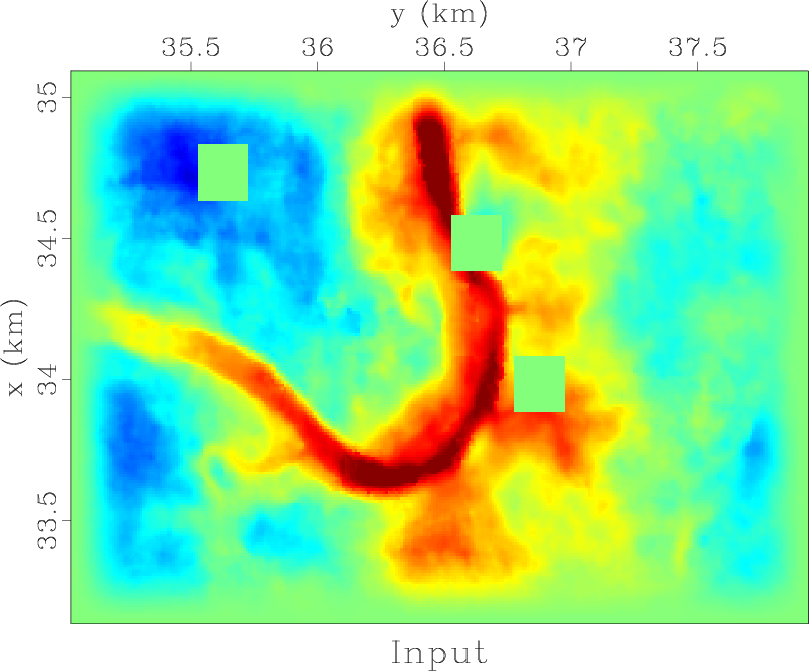
Figure 8. Seismic depth slice after removing selected parts of the data. |
|
|---|---|
![[scons]](icons/configure.png)
|
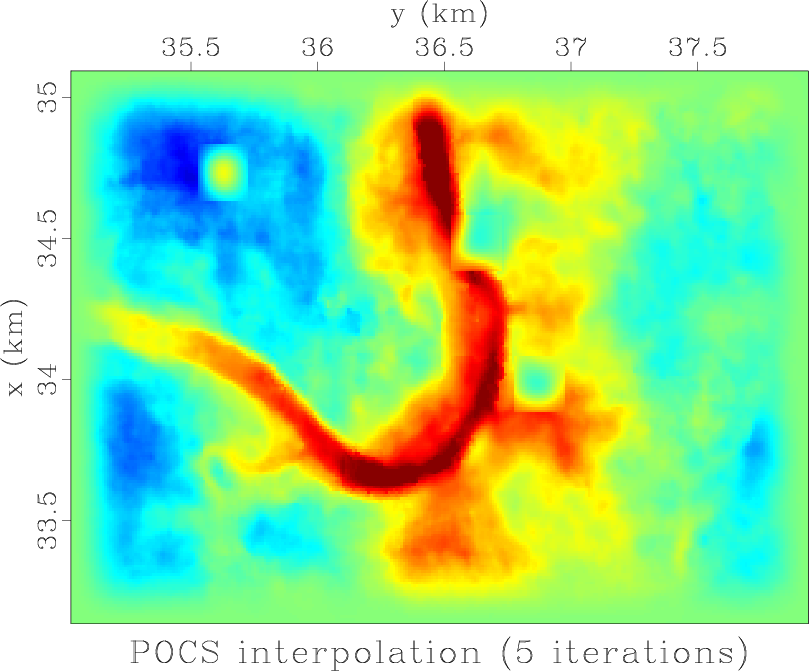
The goal of the next exercise is to figure out if one can use compactness of the Fourier transform to reconstruct missing data. The missing parts are created artificially by cutting holes in the original data (Figure 8).
|
|---|
|
fft-data,fft-hole
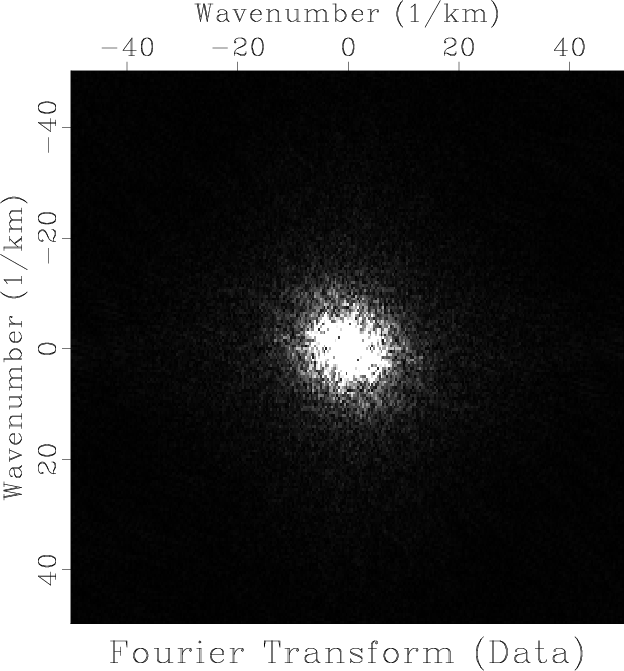
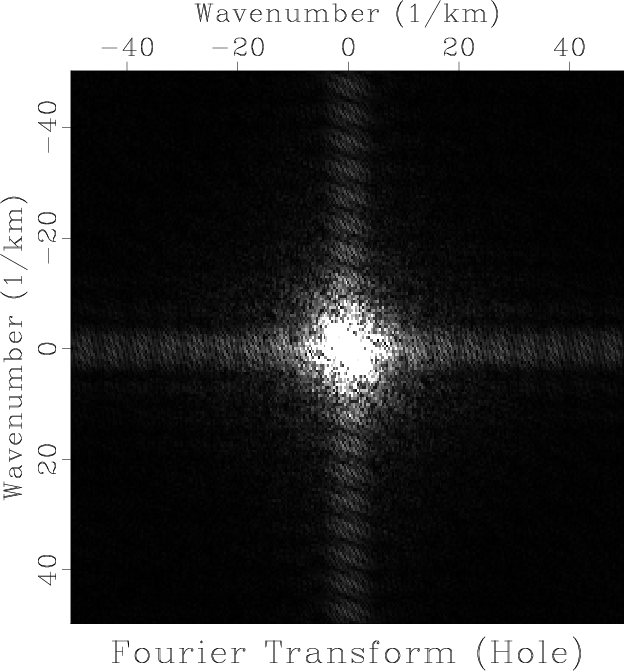
Figure 9. Fourier transform of the original data (a) and data with holes with holes (b). The absolute value is displayed |
|
|
|
fft-mask
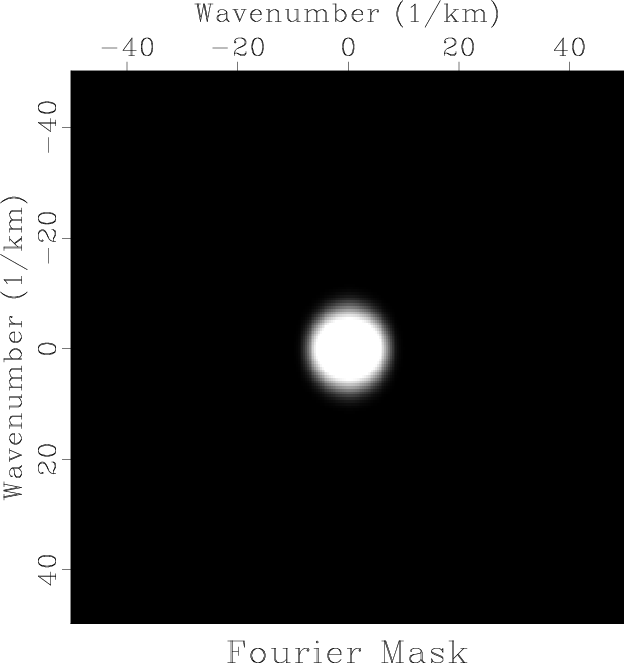
Figure 10. Fourier-domain mask for selecting a convex set. |
|
|---|---|
|
|
Figures 9a and 9b show the digital Fourier transform of the original data and the data with holes. We observe again that the support of the data in the Fourier domain is compact thanks to the data smoothness. Cutting holes in the physical domain creates discontinuities that make the Fourier response spread beyond the original support. Figure 10 shows a Fourier-domain mask designed to contain the support of the original data.
To accomplish the task of missing data interpolation, we will use an
iterative method known as POCS (projection onto convex
sets). By definition, a convex set  is a set of
functions such that, for any
is a set of
functions such that, for any
 and
and
 from the set,
 (for
(for
 ) also belongs
to the set. A projection onto a convex set means finding a function in
the set that is of the shortest distance to the given function. The
POCS theorem states that if one wants to find a function that belongs
to the intersection of two convex sets
) also belongs
to the set. A projection onto a convex set means finding a function in
the set that is of the shortest distance to the given function. The
POCS theorem states that if one wants to find a function that belongs
to the intersection of two convex sets  and
and  , the task can
be accomplished iteratively by alternating projections onto the two
sets (Youla and Webb, 1982).
, the task can
be accomplished iteratively by alternating projections onto the two
sets (Youla and Webb, 1982).
In our example, is the set of all functions that are equal to
the known data outside of the holes. is the set of all functions
that have a predifined compact support in the Fourier domain (and
therefore are smooth in the physical domain). The algorithm consists
of the following steps:
|
pocs
Figure 11. Missing data interpolated by iterative projection onto convex sets. |
|
|---|---|
|
|
from rsf.proj import *

# Download data
Fetch('horizon.asc','hall')

# Convert format
Flow('data','horizon.asc',
     '''
     echo in=$SOURCE data_format=ascii_float n1=3 n2=57036 |
     dd form=native | window n1=1 f1=-1 | add add=-65 |
     put
     n2=291 o2=35.031 d2=0.01 label2=y unit2=km
     n1=196 o1=33.139 d1=0.01 label1=x unit1=km |
     costaper nw1=25 nw2=25
     ''')

# Display
def plot(title):
    return '''
    grey color=j title="%s"
    transp=y yreverse=n clip=14
    ''' % title
Result('data',plot('Horizon'))

# Cut three square holes (!!! CHANGE ME !!!)
cut = '''
cut n1=20 n2=20 f1=125 f2=150 |
cut n1=20 n2=20 f1=150 f2=50  |
cut n1=20 n2=20 f1=75  f2=175
'''

Flow('hole','data',cut)
Flow('mask','data',
     'math output=1 | %s | math output=1-input' % cut)
Plot('hole',plot('Input'))
Result('hole','Overlay')

# Fourier transform
forw = 'rtoc | fft3 axis=1 pad=1 | fft3 axis=2 pad=1'
back = 'fft3 axis=2 inv=y | fft3 axis=1 inv=y | real'

for data in ('data','hole'):
    fft = 'fft-'+data
    Flow(fft,data,forw)
    Result(fft,
           '''
           math output="abs(input)" | real |
           grey allpos=y title="Fourier Transform (%s)"
           screenratio=1
           ''' % data.capitalize())

# Create Fourier mask
Flow('fft-mask','fft-hole',
     '''
     real | math output="x1*x1+x2*x2" | mask min=50 |
     dd type=float | math output=1-input |
     smooth rect1=5 rect2=5 repeat=3 | rtoc
     ''')
Result('fft-mask',
       '''
       real |
       grey allpos=y title="Fourier Mask" screenratio=1
       ''')

# POCS iterations
niter=5 # !!! CHANGE ME !!!

data = 'hole'
plots = ['hole']
for iter in range(niter):
    old = data
    data = 'data%d' % iter

    # 1. Forward FFT
    # 2. Multiply by Fourier mask
    # 3. Inverse FFT
    # 4. Multiply by space mask
    # 5. Add data outside of hole
    Flow(data,[old,'fft-mask','mask','hole'],
         '''
         %s | mul ${SOURCES[1]} |
         %s | mul ${SOURCES[2]} |
         add ${SOURCES[3]}
         ''' % (forw,back))
    Plot(data,plot('Iteration %d' % (iter+1)))
    plots.append(data)
# Put frames in a movie
Plot('pocs',plots,'Movie',view=1)

# Last frame
Result('pocs',data,
       plot('POCS interpolation (%d iterations)' % niter))

End()
|
Your task:
scons viewto reproduce the figures on your screen.
scons pocs.vplto see a movie of different iterations.
|
|
|
|
| Homework 3 | |
|